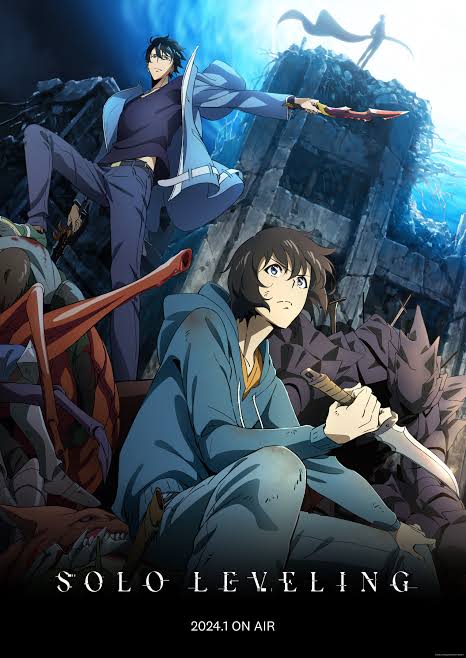
Solo Leveling
Introduction
The most memorable moment in Solo Leveling Season 1 isn’t actually Jinwoo winning a fight.
It is the moment before that transformation becomes believable.
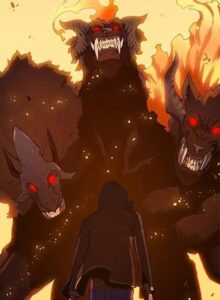
In the opening episodes, Sung Jinwoo is so physically outmatched that even surviving a routine dungeon raid feels like an achievement. Then Episode 1 throws him into the Cartenon Temple, where the series establishes a simple but brutal idea: being weak in this world isn’t merely embarrassing; it can get you killed.
From there, Solo Leveling builds around one extremely satisfying question: what happens when the weakest person in the room finally gets a way to improve?
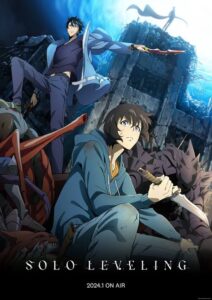
A-1 Pictures adapts the original webtoon with a strong focus on Jinwoo’s progression, dungeon combat and increasingly intimidating presentation. The first season aired from January 6 to March 30, 2024, across 12 episodes.
What makes the season work isn’t that its premise is completely new. It isn’t. The appeal comes from how efficiently it turns progression itself into entertainment.
Overview
Solo Leveling takes place in a world where mysterious Gates connect modern society to monster-filled dungeons. Humans who awaken supernatural abilities become Hunters, and their ranks generally remain fixed after awakening.
Sung Jinwoo is an E-rank Hunter and is widely regarded as the weakest Hunter in humanity. He keeps entering dungeons because his family situation leaves him with few alternatives.
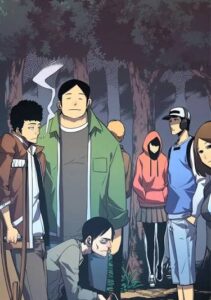
During one raid, Jinwoo and the other Hunters discover something far more dangerous than the dungeon they expected. After the encounter nearly kills him, a mysterious System appears before him.
Unlike ordinary Hunters, Jinwoo can now level up.
That single mechanic changes the entire structure of his life.
The clever part of the premise is that the System doesn’t immediately turn Jinwoo into an unstoppable hero. Early episodes make you watch him earn every improvement. His physical changes, new abilities and growing confidence therefore feel connected to what happened to him rather than simply being handed over by the story.
The official anime site describes the same central distinction: Hunters normally cannot increase their abilities or rank after awakening, while Jinwoo becomes the exception through the System.
Story Summary — Spoiler-Free
Season 1 is essentially a progression story disguised as a dungeon-action anime.
The early episodes spend considerable time establishing just how vulnerable Jinwoo is. That matters because the series wants you to remember the version of him who struggles with ordinary monsters before introducing the version capable of walking into increasingly dangerous situations alone.
The story moves through several types of challenges rather than staying inside one dungeon for the entire season. Jinwoo learns how the System works, experiments with his new abilities, takes on different dungeon environments and gradually discovers that simply becoming stronger is not the end of the mystery.
The pacing becomes noticeably more action-heavy as the season progresses. Episodes 1 and 2 are comparatively tense and survival-focused, while later episodes increasingly resemble a power-progression fantasy.
The tone also changes with Jinwoo.
At the beginning, there is genuine anxiety whenever he enters a dungeon. Later, the question becomes less “Can Jinwoo survive?” and more “What is Jinwoo going to do to these enemies?”
That change is the season’s central dramatic trick.
And because the anime stops at the Job Change storyline, Season 1 feels more like the beginning of Jinwoo’s larger transformation than a complete story with every major mystery resolved.
Main Characters
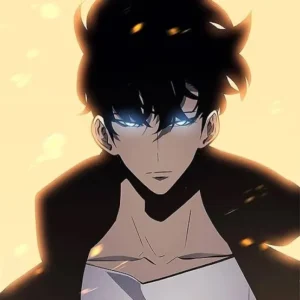
Sung Jinwoo
Jinwoo is obviously the center of the series, but his appeal isn’t simply that he becomes powerful.
His most interesting characteristic is how practical he becomes.
Early Jinwoo is constantly calculating whether he can survive an encounter. Once the System gives him a genuine path to improvement, he starts treating his own body almost like a project. Training, stat allocation, quests and dungeon rewards become tools rather than abstract game mechanics.
That makes his progression satisfying because his personality changes alongside his abilities.
The Jinwoo who enters the later dungeon battles is not merely an E-rank Hunter with bigger numbers. He has learned to think like someone who expects to survive.
Yoo Jinho
Jinho could have easily been written as disposable comic relief.
Instead, he becomes one of the season’s most useful contrasts to Jinwoo.
He has money, family connections and access to equipment, but he lacks Jinwoo’s combat ability. Their partnership therefore isn’t simply “strong guy plus funny sidekick.” Jinho’s presence gives Jinwoo someone to interact with when the story isn’t trying to make him look intimidating.
His loyalty also becomes increasingly important because Jinwoo’s rapid growth could otherwise isolate him completely.
Cha Hae-in
Cha Hae-in receives less development in Season 1 than her popularity might suggest.
She is an S-rank Hunter and one of the strongest figures introduced, but the season mostly uses her as a glimpse into the larger Hunter hierarchy rather than giving her a complete character arc.
That isn’t necessarily a flaw in the character herself. It is more a consequence of how much material Season 1 is trying to establish before Jinwoo’s story expands.
Lee Joohee
Joohee is important because she represents the human cost of the Hunter profession.
Unlike Jinwoo, who increasingly adapts to the violence surrounding him, Joohee’s reactions remind us that dungeon raids aren’t video-game matches for everyone involved.
Her fear and trauma after the early dungeon events make the world feel more dangerous than Jinwoo’s later victories might suggest.
Go Gunhee
Go Gunhee doesn’t dominate Season 1, but his presence gives the Hunter Association more weight.
He represents the older generation of people who understand that Jinwoo’s sudden development may have consequences beyond another Hunter simply becoming stronger.
The anime also introduces several important figures earlier than the manhwa did, helping establish that Jinwoo’s transformation exists inside a much larger Hunter system.
Why You Should Watch Solo Leveling Season 1
The obvious reason is the action, but the better reason is progression you can actually feel.
Episode 1 establishes Jinwoo as someone who has to calculate whether ordinary monsters are survivable. Later episodes deliberately reverse that relationship.
The contrast becomes particularly effective around Episodes 6–7, when Jinwoo’s confidence has changed enough that entering a dungeon no longer produces the same kind of fear.
Then Episode 12, “Arise,” turns the season’s entire progression philosophy into one major payoff. The Job Change quest forces Jinwoo through repeated battles until the person who once struggled to survive is confronting a completely different scale of threat.
That is the point where Solo Leveling understands exactly what its audience came for.
Animation & Art Style
A-1 Pictures’ biggest success is understanding that Jinwoo’s transformation needs to be visible.
The series gradually shifts his visual presentation from an exhausted, physically unimpressive Hunter into someone who can dominate a frame simply by standing still.
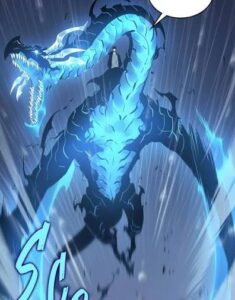
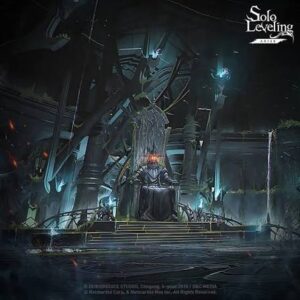
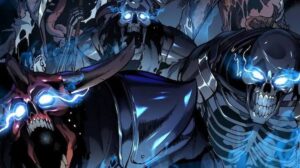
The action direction is especially effective when Jinwoo fights at close range. His movement becomes cleaner and more deliberate as he grows stronger. The series also makes heavy use of dark backgrounds, blue/purple lighting and high-contrast effects around the System and dungeon environments.
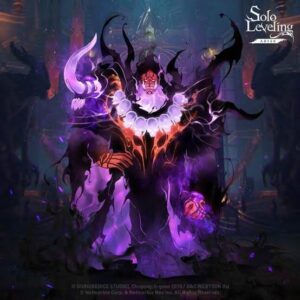
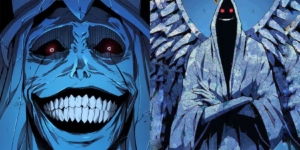
The Cartenon Temple sequence is the strongest example.
The enormous statues, geometric temple design and unnatural expressions create an atmosphere that feels different from a normal fantasy dungeon. The visual language tells you immediately that Jinwoo has walked into something that doesn’t follow the normal rules of the Hunter world.
The production staff specifically credits action direction to Yoshihiro Kanno, with A-1 Pictures handling animation production.
The weakness is that not every ordinary scene receives the same visual attention. The series clearly saves much of its animation impact for moments that matter to Jinwoo’s progression.
Music & Voice Acting
Hiroyuki Sawano is responsible for the music, and his style fits Solo Leveling almost suspiciously well.
The soundtrack uses heavy electronic and orchestral elements that make Jinwoo’s fights feel larger than the surrounding story.
The standout example is “DARK ARIA,” performed by SawanoHiroyuki featuring XAI. The track appears in Episode 6 and is specifically listed by the official anime site as part of the episode’s music.
The opening, “LEveL,” is performed by SawanoHiroyuki[nZk]:TOMORROW X TOGETHER, while “request” by krage serves as the ending theme.
For English viewers, Aleks Le voices Jinwoo in the English dub, with Justin Briner as Jinho and Michelle Rojas as Cha Hae-in.
The English dub premiered on Crunchyroll on January 20, 2024.
Where to Watch Solo Leveling Season 1
This is one area where Solo Leveling is particularly convenient.
Crunchyroll is the main streaming destination for Season 1 in India, and its current listing provides all 12 episodes with both subtitles and multiple dubbed audio options, including English, Hindi, Tamil and Telugu.
Crunchyroll originally launched the series in India simultaneously with its international premiere on January 6, 2024. Its initial announced territories included North America, Europe, the Middle East, Africa, Oceania and India.
For Indian viewers, the language options are a particularly useful part of the release. The English dub began later than the Japanese broadcast, while the Hindi, Tamil and Telugu versions followed their own schedules.
So if you’re watching in India today, the simplest route is:
Crunchyroll → Solo Leveling → Season 1
The current Crunchyroll listing labels every Season 1 episode as available in both sub and dub formats, although the exact language availability can depend on region and account location.
Solo Leveling vs Other Power-Progression Anime
If you’re choosing between Solo Leveling and One Punch Man, the difference is straightforward.
One Punch Man is fundamentally playing with the idea of an overpowered protagonist. Saitama’s strength is part of the joke.
Solo Leveling treats increasing strength as the actual entertainment.
Jinwoo becoming stronger is not something the story expects you to laugh at. The entire structure is built around watching him move from one level of ability to another.
Compared with Sword Art Online, Solo Leveling is much less interested in building a huge virtual-world adventure during its first season. Its progression loop is considerably more direct: fight, obtain rewards, improve, enter a harder challenge.
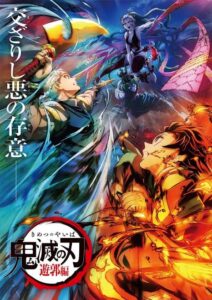
And compared with Demon Slayer, the priorities are different again. Demon Slayer spends more time on relationships, emotional backstories and ensemble characters. Solo Leveling puts far more narrative weight on one character’s progression.
So the choice depends heavily on what you want from the experience.
If your main attraction is watching a weak protagonist steadily become terrifyingly powerful, Solo Leveling is built almost entirely around that pleasure.
Manga vs Anime: Should You Read the Manhwa?
Yes — especially if you enjoy visual storytelling.
The anime is a strong adaptation, but it isn’t a panel-for-panel reproduction. Some scenes were changed, reordered or expanded to work better in animation. For example, the anime alters portions of the Double Dungeon sequence and introduces some material earlier to establish characters and the wider Hunter world.
One particularly interesting adaptation choice concerns Kim Sangshik. His death is handled differently between the two versions, with the manhwa placing more emphasis on his memories and family immediately around the event, while the anime restructures that material.
The anime also benefits from movement and sound in places where the manhwa relied on still artwork.
But the manhwa has one advantage that animation cannot completely reproduce: DUBU’s original panel composition.
If you finish Season 1 and want to continue the story, reading from the beginning isn’t strictly necessary. But reading the corresponding material gives you a different version of Jinwoo’s progression and lets you see how the original webtoon handled certain scenes.
The Thing Solo Leveling Doesn’t Do as Well as the Hype Suggests
Jinwoo is fascinating to watch, but the supporting cast doesn’t receive equivalent attention.
This becomes increasingly obvious as the season progresses.
Characters such as Joohee, Jinho, Cha Hae-in and the various higher-ranked Hunters have interesting possibilities, but Season 1 often treats them as pieces surrounding Jinwoo rather than fully developed leads.
That’s intentional to some degree. The story is designed around Jinwoo’s progression.
But it also means that viewers looking for a deeply developed ensemble may finish the season feeling that several characters were introduced primarily because they will matter later.
The same issue affects the emotional side of the story.
Jinwoo’s transformation is visually and mechanically satisfying, but the anime sometimes moves so quickly from one achievement to the next that the emotional consequences of those achievements don’t receive the same attention as the action itself.
That isn’t a fatal weakness.
It simply means Solo Leveling is much stronger as a power-progression fantasy than as a character ensemble drama in Season 1.
Strengths
Jinwoo’s progression feels measurable
The System gives the audience concrete signs of growth instead of asking us to accept that the protagonist is suddenly stronger.
Excellent action payoff
The later dungeon fights work because the series spent time establishing how weak Jinwoo originally was.
Strong visual identity
The dark blue/purple presentation, System interfaces and increasingly intimidating Jinwoo create a recognizable aesthetic.
Excellent music pairing
Sawano’s soundtrack gives important fights a sense of scale that the visuals alone wouldn’t provide.
Strong season-ending payoff
Episode 12 doesn’t merely finish another fight. It completes the first major stage of Jinwoo’s transformation.
Weaknesses
The biggest weakness is supporting-character depth.
Jinwoo receives almost all of the narrative investment, which means other characters can feel like introductions to future storylines rather than complete arcs.
The second issue is that the series can become predictable once you understand its progression formula.
Jinwoo encounters an obstacle.
He struggles.
He obtains a new ability.
He returns stronger.
The fun comes from seeing how he gets stronger and what the next ability looks like, rather than wondering whether the protagonist will eventually become powerful.
For some viewers, that will be exactly the appeal.
For others, it may make the story feel mechanically repetitive.
Who Should Watch This Anime?
Watch Solo Leveling Season 1 if you enjoy:
- Overpowered-protagonist stories
- RPG-style progression systems
- Dungeon crawling
- Solo fights
- Dark fantasy settings
- Characters who visibly grow stronger
- Spectacle-driven action
- Webtoon adaptations
It is particularly easy to recommend to someone who doesn’t want a 100-episode commitment before the story becomes interesting.
Season 1 gets to its central premise quickly and keeps the progression moving.
Who Should Skip This Anime?
You may want to skip it if your main reason for watching anime is a large ensemble cast with deeply developed relationships.
You should also temper expectations if you dislike stories where the protagonist becomes overwhelmingly stronger than most of the surrounding cast.
And if you need every supporting character to receive a substantial emotional arc, Season 1 may feel uneven.
The series is not trying to be March Comes in Like a Lion or Vinland Saga.
Its main pleasure is much simpler:
watch Jinwoo level up.
Final Verdict
Solo Leveling Season 1 knows exactly what its strongest idea is and doesn’t waste much time pretending otherwise.
The Cartenon Temple establishes the danger. The System establishes the progression mechanic. The early dungeon battles show Jinwoo learning how to use it. The later episodes demonstrate what happens when those improvements start accumulating. Episode 12 finally gives the season the transformation payoff it has been building toward.
Its supporting cast could use more room, and its emotional storytelling occasionally sits behind its action priorities. But those weaknesses don’t erase what the series does exceptionally well.
The most important achievement of Season 1 is that Jinwoo’s transformation doesn’t happen in one dramatic jump.
You watch the difference.
The exhausted E-rank Hunter from Episode 1 gradually becomes someone who walks into battles with an entirely different attitude.
And when the season finally reaches “Arise,” the title feels earned.
For viewers who enjoy progression fantasy, dungeon action and protagonists who become stronger in clearly visible stages, Solo Leveling Season 1 is an unusually direct version of that formula.
FOR SEASON 2 Read Here : Solo Leveling Season 2: Arise from the Shadow