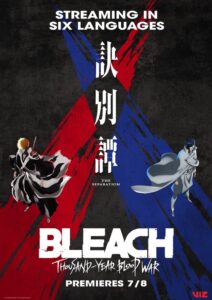
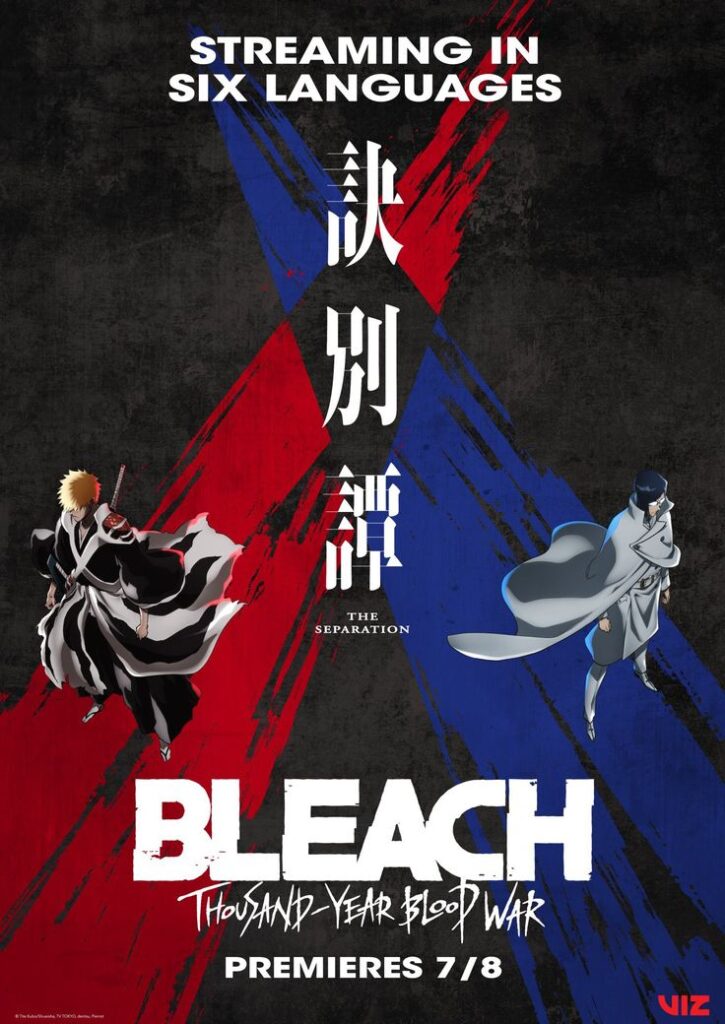
Bleach: Thousand-Year Blood War Part 2 – The Separation
Introduction
Bleach: Thousand-Year Blood War Part 2 – The Separation has one enormous advantage over most second parts of anime arcs: it knows exactly what the first cour changed.
Ichigo Kurosaki no longer has the luxury of believing that his powers are simply the result of being a Substitute Soul Reaper. His Zanpakuto has been destroyed, the truth about his heritage has come out, and the war with Yhwach’s Quincy army has exposed how little the Soul Reapers actually understood about their own history.
Then Uryu Ishida does something that makes everything personal.
He joins Yhwach.
That decision gives Part 2 its identity.
Instead of simply continuing the first invasion, The Separation turns the war into something much more fractured. Allies are separated. Old assumptions about Ichigo’s powers are dismantled. Captains begin revealing abilities that had been teased for years. And the Wandenreich stops feeling like an army that can be defeated simply by throwing stronger Soul Reapers at it.
Part 2 is where Bleach starts behaving like the final arc it promised to be.
Overview
The story resumes after the first part of the Thousand-Year Blood War, with Ichigo having learned the truth about his mixed Soul Reaper and Quincy heritage.
The official story description frames this stage around Ichigo returning to battle with newly understood powers while Uryu takes a completely different path after uncovering more about the Quincy side of the conflict. Yhwach also announces that the final nine days of the world have begun.
That setup creates two parallel stories.
Ichigo is trying to understand himself well enough to protect everyone around him.
Uryu is apparently moving toward the people who have spent the entire arc trying to destroy Ichigo’s allies.
The title The Separation therefore isn’t just referring to characters being physically split across battlefields.
It describes the emotional situation of the entire cast.
The Soul Reapers have been separated from their Bankai.
Ichigo has been separated from his old understanding of Zangetsu.
Uryu has separated himself from his friends.
And the Soul Society itself is being forced to confront a history it would rather have forgotten.
That gives this cour more thematic cohesion than its collection of fights might initially suggest.
Story Summary: What Happens in Part 2?
Part 2 begins with the Soul Reapers preparing for the next stage of the war while Ichigo continues training at the Royal Palace.
The immediate problem is that Ichigo cannot simply return to the battlefield and repeat what happened during the first invasion. He needs a new understanding of his powers.
At the same time, Yhwach announces Uryu Ishida as his successor.
That announcement creates immediate tension within the Wandenreich. Even Uryu himself questions why Yhwach has chosen him.
From there, the season divides its attention between several fronts.
Ichigo’s return leads into one of the cour’s most important emotional threads: the confrontation between what he thought he knew about his Zanpakuto and what Zangetsu actually represents.
The Sternritter also receive considerably more attention.
Characters who were mostly names and abilities in the first cour now get actual battles, personalities and reasons for their powers. Kenpachi Zaraki’s fight against Gremmy, Rukia’s confrontation with Äs Nödt and the later battles involving the Bambies are examples of the season finally cashing in some of the Sternritter’s potential.
The second half becomes increasingly chaotic.
Zombies appear.
Multiple Sternritter collide with Soul Reapers.
Uryu directly stands in Ichigo’s way.
And Yhwach’s objective becomes much more important than simply defeating the Gotei 13.
The season ultimately ends with the conflict moving toward the Royal Palace and the next stage of the war.
That ending is deliberately incomplete.
Part 2 isn’t designed to be a conclusion.
It’s the point where the battlefield becomes too large for Ichigo to simply solve the war by himself.
Main Characters
Ichigo Kurosaki
Part 2 gives Ichigo one of his most important developments in the entire series because his relationship with Zangetsu is fundamentally recontextualized.
The story doesn’t simply hand him a stronger sword and move on.
Ichigo has to understand where his powers came from.
That matters because his identity has always been the central contradiction of Bleach. He is a Soul Reaper, but he is also a Quincy and possesses Hollow powers.
Part 2 finally makes those contradictions part of the same character rather than separate power-ups.
His new Zanpakuto therefore feels more meaningful than another upgrade.
It represents Ichigo finally accepting the different parts of himself.
Uryu Ishida
Uryu is arguably the most interesting character in this cour.
Not because his actions are immediately easy to understand, but because the anime refuses to make his decision simple.
He joins Yhwach despite everything he has experienced alongside Ichigo.
That is a gigantic betrayal on the surface.
But Uryu’s history with the Quincies and his connection to his mother make his position more complicated than “Uryu became evil.”
The official character material describes him as one of the last surviving Quincy descendants and confirms his new position among the Sternritter.
Part 2 works best whenever the story treats Uryu as someone caught between two histories rather than simply switching teams.
Rukia Kuchiki
Rukia gets one of the cour’s most memorable battles.
Her fight with Äs Nödt is important not merely because of the new ability she reveals, but because the battle allows the character’s growth to become visible through combat.
Rukia’s relationship with fear is especially relevant.
Äs Nödt’s entire ability is built around forcing an opponent to experience terror, yet Rukia’s response demonstrates how far she has progressed.
The scene also gives her Bankai a presentation worthy of the build-up.
Byakuya Kuchiki
Byakuya’s return to the battlefield carries more emotional significance because of everything that happened to him in the first invasion.
His relationship with Rukia has also changed.
Instead of simply being the distant captain who once opposed her, he now acts much more openly as someone who recognizes her strength.
The way he interacts with Rukia after her battle with Äs Nödt is a small character moment, but it says more about their relationship than another dramatic speech would have.
Kenpachi Zaraki
Kenpachi’s fight against Gremmy is exactly the kind of ridiculous power escalation that Bleach can get away with when it is executed properly.
Gremmy’s imagination is potentially absurdly powerful.
Kenpachi’s answer is essentially to become the larger monster.
The fight works because it isn’t trying to be intellectually complicated.
It is a clash between two characters whose abilities are fundamentally difficult to contain.
And Kenpachi finally gets to demonstrate why the story has spent so long treating him as one of the Soul Society’s greatest threats.
Yhwach
Yhwach becomes increasingly frightening because he doesn’t need to personally fight everyone to control the war.
His influence over the Quincy army and his ability to alter the balance of power make him feel more like the architect of the conflict than a conventional shonen villain waiting for the final battle.
The title of the cour becomes particularly appropriate around him.
Everyone else is reacting to separation.
Yhwach is exploiting it.
Why You Should Watch
If Part 1 convinced you that the Thousand-Year Blood War adaptation was finally giving Bleach the production quality its final arc deserved, Part 2 gives you the character payoffs.
The obvious highlights are the major battles.
Rukia versus Äs Nödt is one.
Kenpachi versus Gremmy is another.
The confrontation between Ichigo and Uryu is arguably more important than either because the emotional stakes are completely different.
The episode “Marching Out the Zombies” is especially useful for understanding the season’s structure. Ichigo learns that Uryu is actively preventing the Soul Reapers from stopping Yhwach’s advance, while the other characters are forced into their own simultaneous fights.
The result is a cour where the cast finally feels like it is fighting a genuine war rather than waiting for Ichigo’s next transformation.
That is the biggest improvement.
Animation & Art Style
The modern Bleach production understands that the series’ best visual moments aren’t always the ones with the largest explosions.
The character design remains one of its strongest assets.
Masashi Kudo’s updated designs preserve the recognizable silhouettes of the original anime while giving the Thousand-Year Blood War a sharper and more mature appearance. The official staff credits Kudo as character designer and Pierrot Films as the animation production studio.
Part 2 also benefits enormously from controlled color palettes.
Rukia’s Bankai sequence is a good example. The visual presentation intentionally emphasizes coldness and stillness rather than turning the transformation into a conventional explosion of energy.
Kenpachi’s fight with Gremmy goes in the opposite direction.
The battle becomes progressively more exaggerated as Gremmy’s imagination creates increasingly absurd situations.
That contrast works because the production doesn’t give every character the same visual treatment.
The biggest weakness is that not every episode can maintain the spectacular quality of the cour’s best fights.
There are quieter episodes where the production relies more heavily on dialogue, still frames and compositing.
That’s not necessarily bad.
It simply means screenshots of the most spectacular episodes can create an expectation that every minute of the cour looks like a movie.
It doesn’t.
The peaks are excellent.
The baseline is much more conventional.
Music & Voice Acting
There is probably no series in which Shiro Sagisu’s musical identity is more recognizable than Bleach.
His score continues to combine orchestral writing, electronic textures and vocal-driven tracks in a way that immediately makes the series feel like Bleach.
The official staff credits Sagisu as composer for the Thousand-Year Blood War adaptation.
Part 2’s opening theme, “STARS” by w.o.d., gives the cour a noticeably different energy from the first part, while “Endroll” by Yoh Kamiyama serves as its ending theme.
The voice acting is particularly strong in the scenes involving Uryu.
Noriaki Sugiyama has to play Uryu differently once he joins the Wandenreich. He can’t simply sound like the same Uryu who used to argue with Ichigo during the Arrancar arc.
There needs to be distance.
At the same time, the performance has to leave enough uncertainty that viewers can question whether the betrayal is genuine.
Masakazu Morita’s Ichigo provides the other side of that dynamic. Ichigo’s reaction to Uryu works because it sounds less like hatred and more like disbelief.
That distinction matters.
These are supposed to be friends.
The Separation Is More Than a Story Title
The most interesting thing about Part 2 is that its title actually describes the storytelling.
Consider what happens to the major characters.
Ichigo is separated from his old understanding of his powers.
Uryu separates himself from Ichigo and the Soul Reapers.
Rukia and Renji are repeatedly separated from the battles they want to fight.
The Gotei 13 is fractured by the loss of Bankai.
Even the audience’s understanding of the series is being separated from what it believed about the original Bleach mythology.
The first thousand years of the Quincy-Soul Reaper conflict were built on incomplete information.
Now those missing pieces are being revealed.
That is why the lore additions in this cour work better than simply introducing another group of powerful enemies.
The war isn’t just getting bigger.
The meaning of the old conflict is changing.
This is also why Ichigo’s new Zanpakuto matters beyond its combat ability.
His new weapons are the physical result of understanding himself.
That is much more satisfying than “Ichigo trained for ten episodes and unlocked an upgrade.”
The Best and Worst Thing About Part 2: It Is Still Bleach
There is a specific kind of Bleach fan who will love this cour.
They don’t necessarily need every fight to have complicated strategy.
They want characters to arrive at the battlefield, reveal an ability that has been teased for years, say something cool and then completely destroy the visual composition of the screen.
Part 2 understands that appetite.
Rukia’s Bankai.
Kenpachi’s fight.
The Bambies.
The Royal Palace.
The new forms.
The Sternritter abilities.
It is extremely good at spectacle.
But this is also where the cour can frustrate viewers who want every battle to be tactically deep.
Some fights essentially come down to discovering what absurd ability the opponent has and then discovering the even more absurd ability required to counter it.
That is classic Bleach.
I enjoy it.
But I wouldn’t pretend it is the same kind of battle writing found in Hunter x Hunter or World Trigger.
If you want carefully constructed tactical combat, this isn’t the strongest example.
If you want stylish characters with ridiculous powers and enormous dramatic presentation, it is almost impossible to beat.
Strengths
- Ichigo’s heritage finally feels integrated into his character rather than treated as separate power systems.
- Uryu receives meaningful attention and becomes central to the conflict.
- Rukia gets one of the cour’s strongest character-and-battle combinations.
- Kenpachi versus Gremmy delivers exactly the kind of spectacle fans expect from the character.
- The Sternritter feel more distinct than they did during the first invasion.
- The visual direction makes Bankai and major abilities feel genuinely important.
- The soundtrack retains the unmistakable Bleach identity.
- The cour expands the mythology instead of merely repeating the first invasion.
- The ending creates strong momentum for the next part.
Weaknesses
The biggest problem is density.
There are a lot of characters, powers, factions and simultaneous battles competing for thirteen episodes.
That creates some unevenness.
A character can appear after a long absence, receive an impressive moment and then disappear again because the story needs to move to another battlefield.
The cour also relies heavily on established Bleach knowledge.
If you don’t remember characters such as the Royal Guard, Sternritter or the different Soul Reaper divisions, some scenes can feel like introductions arriving several hundred episodes too late.
Another issue is that the story sometimes values the reveal of a power over the actual mechanics behind it.
This works brilliantly when the character is Kenpachi.
It is less effective when a Sternritter’s ability becomes so abstract that the fight starts feeling like an explanation followed by a counter-explanation.
Part 2 is spectacular.
It isn’t always elegant.
Who Should Watch This Anime?
You should absolutely watch The Separation if you enjoyed Part 1.
It is particularly good for viewers who want the payoff to Ichigo’s heritage reveal, more Sternritter battles and deeper attention to characters who received limited screen time during the first invasion.
Fans of Rukia, Kenpachi, Uryu and the Royal Guard have plenty to look forward to.
It is also one of the better parts of the Thousand-Year Blood War if your favorite aspect of Bleach is character transformations and Bankai reveals.
The cour assumes you already know the world.
That’s a strength if you’re a longtime fan.
Who Should Skip This Anime?
Don’t start here.
This is not a beginner-friendly entry point into Bleach.
You need the original series and Part 1 because many of the emotional and lore-heavy moments depend on information established years earlier.
You may also want to skip or postpone it if you dislike battle anime where power systems eventually become extremely exaggerated.
The Sternritter abilities can get complicated enough that the fights sometimes become more about surviving an opponent’s special rule than outsmarting them.
If that sounds frustrating rather than exciting, this won’t suddenly change your mind about Bleach.
Final Verdict
Bleach: Thousand-Year Blood War Part 2 – The Separation is where the final arc starts feeling less like a comeback project and more like the conclusion of a story that has been building for years.
Its best material is excellent.
Ichigo’s new understanding of Zangetsu gives his power progression actual emotional meaning. Rukia finally receives a moment that matches her importance to the series. Kenpachi gets the kind of battle his character was practically designed for.
But Uryu is the real wildcard.
His decision to stand beside Yhwach gives the cour a personal conflict that the first invasion didn’t have.
The war isn’t just Soul Reapers versus Quincy anymore.
Friends are standing on opposite sides.
Old histories are being exposed.
And Ichigo is discovering that the person he thought he was has never been the whole story.
Part 2 isn’t flawless. Its large cast and compressed storytelling occasionally make individual battles feel rushed, while some abilities are more spectacular than strategically satisfying.
Still, this is Bleach at its most confident.
Is Bleach: Thousand-Year Blood War Part 2 – The Separation worth watching? Absolutely.
If Part 1 brought Bleach back, Part 2 reminds you why the series became one of the defining battle anime of its generation.
My rating: 9/10