Death Note
Introduction
The most dangerous thing about Death Note isn’t the notebook.
It’s the moment Light Yagami realizes that nobody can stop him.
That distinction is what makes the series work so well. The supernatural notebook is only the mechanism. The real story begins when an exceptionally intelligent teenager is given a power with almost no immediate consequences and decides that his personal idea of justice is enough to govern other people’s lives.
From there, Death Note turns into a strange kind of detective thriller where the person committing the murders and the person trying to solve them are both central characters. The tension doesn’t come from wondering whether Kira exists. It comes from watching Light and L repeatedly try to predict each other’s next move.
Years after its original broadcast, that basic setup still feels unusually direct.
Overview
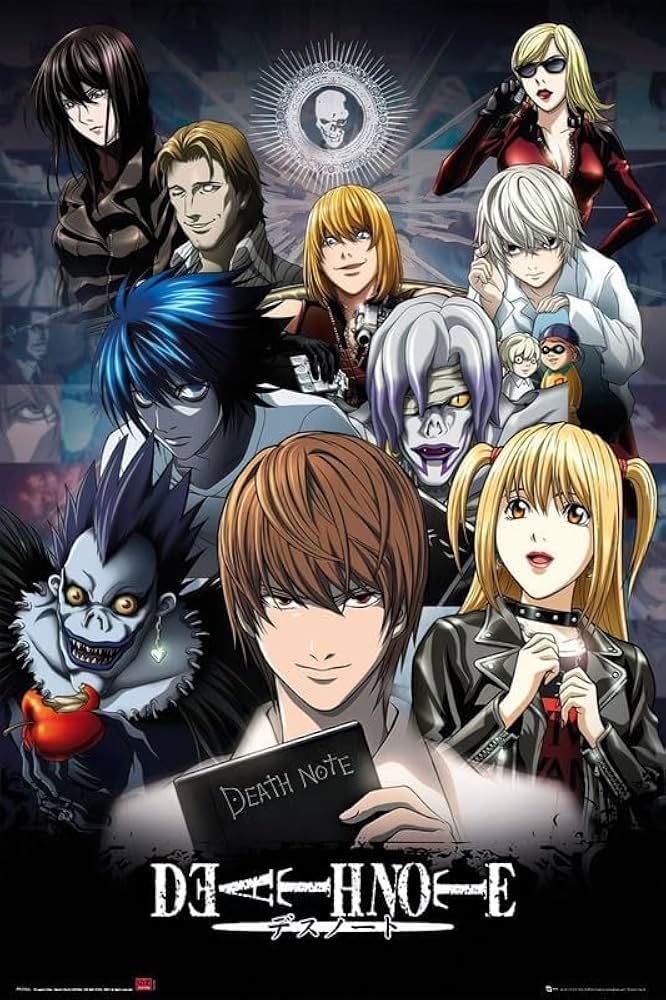
Death Note follows Light Yagami, a highly intelligent Japanese student who discovers a supernatural notebook belonging to the Shinigami Ryuk. Writing someone’s name in the notebook can cause that person to die, provided the user follows the notebook’s rules.
Light initially frames his actions as a way to remove criminals and create a better society. The problem is that he quickly moves beyond punishment of criminals and toward controlling anyone who threatens his vision.
The investigation brings him into conflict with L, an eccentric detective who approaches Kira as a problem of deduction rather than conventional heroism.
The interesting part is that neither side has a straightforward advantage. Light has supernatural power but must hide his identity. L has extraordinary investigative ability but doesn’t know who Kira is.
That creates the central engine of the anime: what happens when two extremely intelligent people know the other exists but cannot prove exactly who they are?
Story Summary: What Kind of Anime Is Death Note?
The first thing to understand about Death Note is that it isn’t an action series disguised as a supernatural anime.
There are very few traditional fights.
Instead, battles happen through conversations, surveillance, manipulation, false assumptions and carefully timed decisions. A person writing a name in a notebook can carry more tension than an entire fight sequence because the audience understands that one tiny mistake can expose the person behind Kira.
The pacing is particularly strong during the early Kira investigation. Light has to maintain an ordinary life while secretly carrying out executions, while L gradually narrows the possibilities surrounding Kira.
Episode 2 is an excellent early example. L doesn’t simply announce that he knows Kira exists; he uses a televised broadcast to provoke Kira and immediately learns something about the killer’s location and personality.
That is the kind of trick Death Note repeatedly builds its suspense around.
The series also changes its rhythm considerably later. After the first major phase of the story, the investigation develops new players and a different kind of conflict. Some viewers find this transition less compelling than the earlier Light-versus-L material.
That criticism is understandable, but the shift is important because it changes the question from “Can L catch Kira?” to something closer to “Can anyone control the monster Light has created?”
Main Characters
Light Yagami
Light is compelling because he doesn’t begin as a cartoonishly evil character.
His first decisions can be interpreted as the actions of someone convinced that ordinary justice is failing. The disturbing part is how quickly that justification becomes secondary to his desire for control.
One of the most revealing things about Light is how naturally he treats other people as pieces on a board. Even when he appears to be cooperating with someone, he is often calculating what that person can do for him.
His intelligence is impressive, but the series becomes more interesting when that intelligence starts serving his ego rather than his original ideal.
L
L is one of anime’s most recognizable detectives for a reason.
He doesn’t behave like the polished genius archetype. His posture is strange, his eating habits are bizarre, and his social behavior can be uncomfortable. Yet these traits don’t exist simply to make him quirky.
They reinforce the way he approaches problems.
L is willing to make unusual accusations and psychological gambles because he cares more about reaching the truth than appearing normal while doing it.
His confrontation with Light works because he isn’t merely solving a case. He is constantly testing Light’s reactions.
Ryuk
Ryuk could easily have become a conventional supernatural mentor, but the series avoids that.
He doesn’t guide Light toward good or evil. He is primarily interested in entertainment.
That makes Ryuk unusually dangerous in a different way. He has access to information Light desperately wants, but Light cannot simply treat him like an obedient ally.
Ryuk’s boredom is one of the reasons the story never feels completely controlled by Light.
Misa Amane
Misa initially looks like she should be a simple romantic complication.
She isn’t.
Her possession of another Death Note changes the strategic situation dramatically, because Light suddenly has to manage someone whose emotional attachment to him is much stronger than her understanding of the larger game.
Misa also exposes one of Light’s biggest weaknesses: his ability to manipulate people becomes much easier when they already want something from him.
Near
Near inherits an enormous narrative problem: following L.
Rather than trying to become another version of L, Near approaches the investigation with a colder, more analytical personality.
His presence becomes particularly important in the final phase because Light can no longer rely on the same relationship dynamics that defined the earlier conflict.
Mello
Mello is almost the opposite of Near.
Where Near is controlled and analytical, Mello is willing to take greater personal risks.
That difference matters because the final investigation isn’t won through one person’s intelligence alone. The actions of multiple people create pressure that eventually makes Light’s carefully constructed system harder to maintain.
Why You Should Watch Death Note
The best reason to watch Death Note is its ability to turn information into suspense.
Episode 25 is an obvious example. The sequence involving Light, L and the investigation doesn’t need a traditional fight to create enormous tension. The emotional weight comes from understanding what the characters know, what they don’t know, and what the viewer suspects might happen next.
The series is also unusually good at making small decisions matter.
A phone call, a surveillance camera, a television broadcast or an apparently harmless conversation can become strategically important several episodes later.
And then there is the famous potato-chip scene.
On paper, Light eating a snack while secretly watching television sounds ridiculous. In execution, the direction turns it into a demonstration of how Death Note treats ordinary actions as potential acts of deception.
That is the show’s real strength.
Animation & Art Style
Madhouse’s animation isn’t impressive because Death Note contains elaborate combat.
Its strength is direction.
Tetsurō Araki frequently uses extreme angles, shadows, close-ups and exaggerated movement to make internal thought feel physically dramatic. Hands, eyes, notebooks, clocks and computer screens receive disproportionate visual attention because those objects are connected to the characters’ decisions.
The visual contrast between Light’s controlled appearance and the increasingly distorted imagery surrounding Kira is particularly effective.
The supernatural elements also have a deliberately unsettling design. Ryuk doesn’t look like a friendly fantasy companion. His enormous frame, skeletal features and exaggerated grin make his presence feel invasive even when he is doing nothing.
The anime’s visual language is sometimes excessive, but that excess is part of its identity.
Music & Voice Acting
The soundtrack by Yoshihisa Hirano and Hideki Taniuchi gives Death Note much of its distinctive atmosphere. The score leans heavily into ominous choral and religious-sounding textures rather than treating the supernatural premise like conventional fantasy.
The Japanese performances are especially memorable.
Mamoru Miyano’s Light changes subtly depending on whether Light is speaking publicly, thinking privately or performing innocence in front of someone else. Kappei Yamaguchi gives L a completely different rhythm, making his strange speech patterns and sudden bursts of intensity feel natural.
The English dub is also worth considering rather than automatically dismissing it. VIZ’s official release includes both English and Japanese audio, and the series has long been distributed with both tracks.
Death Note’s Best Trick: It Makes Intelligence Feel Dangerous
A lot of anime describe a character as a genius and then prove it by having everyone else say how intelligent they are.
Death Note usually takes a better approach.
It lets characters demonstrate intelligence through consequences.
L tests a theory and receives information.
Light creates a plan and has to account for how another person might react.
Then someone else notices something neither of them expected.
This creates a chain where the audience is constantly asked to remember previous information.
The result is almost like watching a chess game where the board keeps changing.
The particularly clever part is that the anime doesn’t always make one side’s plan obvious immediately. Sometimes you understand what Light is attempting only after another character reacts to it.
That makes rewatches surprisingly useful.
Knowing what everyone eventually learns changes the meaning of earlier conversations. A sentence that initially sounds harmless can become suspicious once you understand the character’s actual objective.
Death Note vs Code Geass: Which One Fits You?
If you’re deciding between Death Note and Code Geass, the choice largely depends on what you want from the central conflict.
Death Note is more focused on psychological manipulation and deduction. Its most memorable confrontations happen through information, deception and attempts to predict another person’s behavior.
Code Geass uses a similar idea of a brilliant protagonist gaining an extraordinary power, but it expands much more aggressively into military conflict, rebellion, politics and large-scale action.
For someone who wants a concentrated battle of intelligence, Death Note is the more focused experience.
For someone who wants strategy mixed with mecha battles, political factions and a much larger world, Code Geass offers something substantially different.
The similarities are obvious enough that comparing them makes sense, but they aren’t interchangeable shows.
Manga vs Anime: Should You Read Death Note Too?
The anime adapts the complete original manga story across 37 episodes, rather than stopping before the source material’s conclusion. The manga was written by Tsugumi Ohba and illustrated by Takeshi Obata, while the television adaptation was produced by Madhouse.
The major difference is density.
The manga has more room for internal reasoning, procedural details and smaller transitions. The anime has to compress some of that material and relies on music, editing and voice acting to create tension that the manga creates through panels and internal narration.
This becomes particularly noticeable in the second half.
The anime moves through the later material more quickly than the earlier portion, which can make Near and Mello’s side of the story feel less developed than L’s.
So should anime viewers read the manga afterward?
Yes, if you particularly enjoy the deduction mechanics.
No, if you simply want the complete story. The anime already provides a complete adaptation of the central manga narrative. VIZ also officially describes the TV release as all 37 episodes.
Where to Watch Death Note in 2026
Streaming availability varies heavily by country, so old articles listing Netflix or another service shouldn’t be treated as universally current.
For India specifically, Netflix’s current India catalogue lists DEATH NOTE among its anime titles, but the individual Netflix India title page can produce availability inconsistencies depending on catalogue/session state.
JustWatch’s India listing currently reports the 2006 anime as available through Netflix and Anime Times on Amazon, with 37 episodes.
The important practical point is to check the listing in your own account before subscribing, because licensing can change by territory.
The series is not a simulcast title today. It originally aired from October 2006, and the complete television run consists of 37 episodes.
Strengths
- The Light-versus-L conflict creates unusually strong psychological tension.
- Small pieces of information can become important much later.
- The visual direction makes conversations feel like confrontations.
- Light is written as an intelligent character without making him morally simple.
- The anime has a complete 37-episode story rather than ending on an unresolved manga arc.
- The soundtrack gives the series a distinctive identity.
- The English and Japanese voice tracks are both legitimate ways to experience the show.
Weaknesses
The biggest weakness is the unevenness between the two major portions of the story.
The first major phase has an extremely tight central conflict. Light and L are constantly reacting to one another, and nearly every development feels connected to their duel.
After that structure changes, the story introduces Near and Mello and divides the pressure among more characters. The material isn’t inherently bad, but the anime has fewer episodes to develop this portion, making the transition feel much faster.
This is why some viewers remember Death Note primarily as the Light-and-L story.
There is also a tendency toward theatrical internal monologues. When the show works, these make a simple decision feel enormous. When it doesn’t, the characters can spend too long explaining thoughts that the audience has already understood.
Who Should Watch This Anime?
Watch Death Note if you enjoy detective stories, psychological battles, morally questionable protagonists and plots where information matters as much as physical power.
It’s also a strong entry point for someone who doesn’t normally watch long-running anime. There are no hundreds of episodes to catch up on, and the central story has a clear beginning and conclusion.
If you like shows where you can pause after an episode and ask, “How did that character figure this out?”, you’ll probably get a lot from it.
Who Should Skip This Anime?
Skip it if you primarily want action, tournament battles or a protagonist who consistently behaves like a traditional hero.
You should also avoid it if you dislike stories that spend significant time inside characters’ strategic thinking.
And if you need every major character to receive equal development, the later portion may frustrate you.
Death Note is built around a specific conflict. It doesn’t try to give every character the same narrative importance.
Final Verdict
Death Note remains effective because its core idea is simpler than most of the mythology built around it.
Give one intelligent person the ability to kill almost anyone.
Then give another intelligent person the job of finding him.
Everything else grows from that.
The anime’s strongest material is the early Kira investigation, particularly the period where Light and L are close enough to interact while neither can prove the other’s identity. The later episodes are more compressed and don’t recreate exactly the same chemistry, but they still complete the story rather than leaving it unfinished.
The show’s age is visible in places, especially in its deliberately dramatic presentation. But that theatrical style is also one of the reasons Death Note remains so recognizable.
If you haven’t watched it, the 37-episode anime is still an easy recommendation for viewers interested in psychological thrillers and supernatural mysteries. Just don’t go into it expecting a conventional hero story.
The question isn’t really whether Light is right.
The interesting question is how long he can convince himself that he is.