My Hero Academia
Introduction
My Hero Academia is a superhero-themed shonen anime that combines high-energy action with school life, character development, comedy, friendship, and emotional storytelling. The series takes place in a world where extraordinary abilities are no longer unusual. Instead, supernatural powers known as Quirks have become a normal part of everyday society.
In this world, professional heroes are treated as celebrities, protectors, and public servants. They use their abilities to stop criminals, rescue civilians, and protect society from dangerous villains. For aspiring heroes, becoming a professional is not simply about being strong. They must learn how to control their abilities, make difficult decisions, work with others, and put people’s safety before their own.
The story follows Izuku Midoriya, a teenager who has admired heroes since childhood. His greatest inspiration is All Might, the world’s most famous hero. Unfortunately, Izuku was born without a Quirk, making his dream of becoming a professional hero seem almost impossible.
Despite that obstacle, Izuku refuses to give up.
His journey changes dramatically after a chance encounter with All Might. That meeting gives him an opportunity to pursue the dream he has carried for years and eventually enter U.A. High School, one of the most prestigious hero academies in Japan.
The early episodes of My Hero Academia focus on Izuku’s first steps into this new world. They introduce the concept of Quirks, the responsibilities of professional heroes, U.A. High School, Izuku’s classmates, and the challenges that come with learning to become a hero.
What makes the anime especially appealing is that it does not treat superpowers as the only measure of heroism. The story repeatedly explores courage, selflessness, determination, rivalry, responsibility, and the desire to help others.
For viewers looking for a modern shonen anime with a memorable cast and an accessible superhero setting, My Hero Academia provides a strong starting point.
Overview
My Hero Academia is based on the manga created by Kohei Horikoshi. The manga began serialization in Weekly Shonen Jump in 2014, and the anime adaptation was produced by Bones. The official Shonen Jump description presents the series as a superhero action story set in a society where people with supernatural abilities have become the norm.
The central idea is simple but effective: what would happen if the majority of people were born with superpowers?
Instead of powers being rare or mysterious, Quirks are part of normal life. Children grow up knowing that some people will become heroes, some will work ordinary jobs, and others may use their abilities for criminal purposes.
Professional heroes have therefore become an established part of society.
They are trained to respond to crimes and disasters, and the most successful heroes can become famous public figures. This creates a society where hero rankings, public reputation, and professional success can matter almost as much as the ability to defeat villains.
U.A. High School represents the next stage for young people who want to enter this profession. It is an elite institution with a competitive hero course designed to prepare students for the responsibilities of professional hero work.
Izuku Midoriya begins the story outside this system.
He has no Quirk, but he possesses an extraordinary interest in heroes. He studies their abilities, tactics, personalities, and weaknesses. He may not have the natural advantages of many other students, but he has a genuine desire to save people.
That quality eventually attracts the attention of All Might.
The first episode officially aired in Japan on April 3, 2016. The opening broadcast run consists of 13 episodes and aired through June 26, 2016. Bones identifies the production as its 2016 television adaptation of My Hero Academia.
The opening episodes are primarily concerned with establishing the world and introducing the characters rather than immediately creating a massive conflict. This gives viewers enough time to understand why Izuku wants to become a hero and why U.A. High School is so important to his future.
Story Summary (Spoiler-Free)
My Hero Academia begins in a world where around 80 percent of the population possesses some form of supernatural ability called a Quirk. These abilities can be extremely powerful, completely harmless, highly practical, or surprisingly strange.
Because Quirks have become widespread, society has developed around them.
People with powerful abilities can become professional heroes. These heroes protect civilians and fight villains who use their Quirks for criminal purposes.
Izuku Midoriya is different.
He is part of the minority born without a Quirk.
Growing up without an ability makes Izuku’s dream of becoming a hero seem unrealistic to almost everyone around him. Nevertheless, he continues to admire All Might and believes that being a hero is about more than simply possessing a powerful ability.
Izuku’s life changes when he encounters All Might.
The meeting gives him a chance to pursue the dream that once seemed impossible. However, achieving that dream requires much more than enthusiasm. Izuku must prepare himself physically and mentally for the demanding entrance examination at U.A. High School.
Once he enters the academy, his world becomes much larger.
He meets classmates with a wide variety of Quirks and personalities. Some are friendly and supportive, while others are highly competitive. Among them is Katsuki Bakugo, a talented student whose relationship with Izuku is complicated by their shared history.
Izuku also meets teachers who expect students to take hero training seriously. U.A. may be a school, but its students are preparing for a profession where mistakes can have serious consequences.
The story gradually introduces training exercises that allow students to test their abilities in realistic situations. These exercises are important because raw power alone is rarely enough. Students need to understand how their abilities work, how to cooperate with teammates, and how to react under pressure.
The early story also begins showing that the hero profession is not as safe or simple as it may appear from the outside.
There are villains, risks, and situations that challenge the students’ understanding of what it means to be a hero.
Without revealing major plot developments, the core of the story is Izuku’s growth. He starts with almost no practical experience, but his determination and willingness to learn push him forward.
The official episode description for the first episode establishes this central premise: Izuku dreams of entering U.A. despite being born without a Quirk before his encounter with the world’s leading hero changes his circumstances.
This makes the opening story more than a simple superhero adventure. It is also a coming-of-age story about a teenager discovering what he is capable of and learning what being a hero truly means.
Main Characters
Izuku Midoriya
Izuku Midoriya is the protagonist of My Hero Academia.
He begins the story as a Quirkless teenager who has spent years studying professional heroes. His notebooks are filled with observations about different abilities, fighting styles, and hero techniques.
This habit reveals an important part of Izuku’s personality.
He is analytical and observant. Rather than simply admiring heroes because they are powerful, he pays attention to how they operate.
Izuku is also deeply compassionate.
His instinct is often to help someone in danger even when doing so may put him at risk. This characteristic becomes one of the most important parts of his development.
His journey is not simply about gaining power. He must learn how to use what he has responsibly.
That makes him an approachable protagonist for viewers who enjoy characters who improve through effort rather than starting as naturally gifted heroes.
All Might
All Might is the most famous hero in the world of My Hero Academia and Izuku’s greatest inspiration.
He represents the traditional image of the superhero: powerful, confident, optimistic, and capable of making civilians feel safe simply by arriving at the scene.
His enormous popularity has earned him the title of the Symbol of Peace.
However, All Might is more complicated than his public image suggests. His relationship with Izuku allows the story to explore the difference between being a powerful hero and being a genuinely inspiring person.
All Might becomes an important mentor figure for Izuku.
He helps the young protagonist understand that becoming a hero requires discipline and responsibility, not just a desire to wear a costume.
Katsuki Bakugo
Katsuki Bakugo is one of the most important students introduced early in the story.
He is extremely confident in his abilities and has a highly competitive personality. His Quirk gives him explosive offensive power, which fits his aggressive approach to combat.
Bakugo and Izuku have known each other since childhood, and their relationship is complicated by their very different circumstances.
Bakugo sees Izuku as someone who should not be able to compete with him, while Izuku views Bakugo as both a rival and someone whose natural talent he has respected for years.
Their rivalry adds tension to the school setting and creates another source of motivation for Izuku.
Ochaco Uraraka
Ochaco Uraraka is one of Izuku’s classmates and an aspiring hero with a cheerful personality.
She quickly becomes one of the more approachable members of the class. Her friendly attitude contrasts with some of the more intense personalities around her.
Her Quirk has useful applications in both combat and rescue situations, which fits the broader idea that hero work is not limited to fighting villains.
Ochaco also helps make U.A. feel like a genuine school environment rather than simply a training ground for battles.
Tenya Iida
Tenya Iida is a disciplined and serious student who strongly believes in rules and proper conduct.
His personality can appear overly formal at first, but that strictness comes from his sincere desire to become a responsible hero.
Iida represents one of the story’s recurring ideas: heroism requires responsibility.
He is not interested in becoming a hero simply because heroes are famous. He wants to behave according to the standards he believes a professional should follow.
Shota Aizawa
Shota Aizawa, also known by his hero name Eraser Head, is the homeroom teacher of the hero students.
His teaching style is far less glamorous than the public image of heroes.
Aizawa is practical, demanding, and willing to push students hard. He does not treat them as children who are simply playing with superpowers. He understands that they are preparing for a profession involving real danger.
His presence helps establish a more realistic side of hero education.
Momo Yaoyorozu
Momo Yaoyorozu is one of the students in the hero course and is presented as intelligent, composed, and highly capable.
Her Quirk has enormous potential because of its versatility, but using it effectively requires knowledge and planning.
Momo represents another important idea in the series: having a strong Quirk is not enough. Understanding how to use that ability can be just as important.
Shoto Todoroki
Shoto Todoroki is another notable student introduced within the broader cast of U.A.
Although the opening story does not center on every member of the class equally, Todoroki’s presence helps demonstrate how varied the students’ abilities and personalities can be.
His reserved personality also contrasts strongly with louder characters such as Bakugo.
Tsuyu Asui
Tsuyu Asui is a practical and straightforward student whose frog-like abilities make her one of the more visually distinctive characters in the class.
Her calm personality and useful Quirk make her an effective member of the student group.
Eijiro Kirishima
Eijiro Kirishima is energetic, friendly, and enthusiastic about the idea of becoming a hero.
His personality adds more humor and positive energy to the class while also reinforcing the series’ focus on courage and determination.
Why You Should Watch My Hero Academia
A Simple Concept With Plenty of Depth
One of the biggest advantages of My Hero Academia is how easy the basic premise is to understand.
People have superpowers.
Some become heroes.
Some become villains.
Young people who want to become heroes attend specialized schools.
That is enough information to understand the basic setting.
However, the series builds much more complexity around that simple foundation.
It asks questions about responsibility, social expectations, talent, popularity, and what separates a true hero from someone who simply has heroic abilities.
This makes the series accessible without making the world feel shallow.
Izuku Is an Easy Character to Support
Izuku is not introduced as an unstoppable fighter.
He begins at a major disadvantage.
He lacks the ability that society considers essential for becoming a hero, yet he continues to pursue his goal.
His determination makes his progress satisfying because the viewer can see how much effort he puts into improving.
He also makes mistakes.
That is important.
Izuku does not immediately know how to handle his new responsibilities. He has to learn through experience.
His journey therefore feels like genuine development rather than an instant transformation.
The Quirks Are Creative
The Quirk system is one of the most enjoyable aspects of My Hero Academia.
Characters can possess abilities that are powerful, strange, useful, inconvenient, or highly specialized.
Some Quirks are obviously suited for combat.
Others are better for rescue operations, support, reconnaissance, mobility, or teamwork.
This creates opportunities for battles to involve strategy rather than simply asking which character has the strongest attack.
A weaker ability can become extremely useful when used intelligently.
The School Setting Works Well
The U.A. High School setting gives the anime a natural way to introduce new characters and situations.
Students are still learning.
They have classmates who become friends and rivals.
They have teachers who challenge them.
They participate in training exercises.
This structure makes character development feel natural.
Instead of introducing a completely new location every few episodes, the series can develop the same group of characters while gradually increasing the difficulty of their training.
Strong Themes About Heroism
The series repeatedly returns to the idea that being a hero is more than having power.
A person can possess an impressive Quirk but still lack the qualities needed to protect others.
At the same time, someone with less natural talent can demonstrate extraordinary courage.
This distinction is central to Izuku’s story.
The anime therefore works on two levels. It is an entertaining superhero adventure, but it also explores why people admire heroes and what those heroes owe to society.
Animation & Art Style
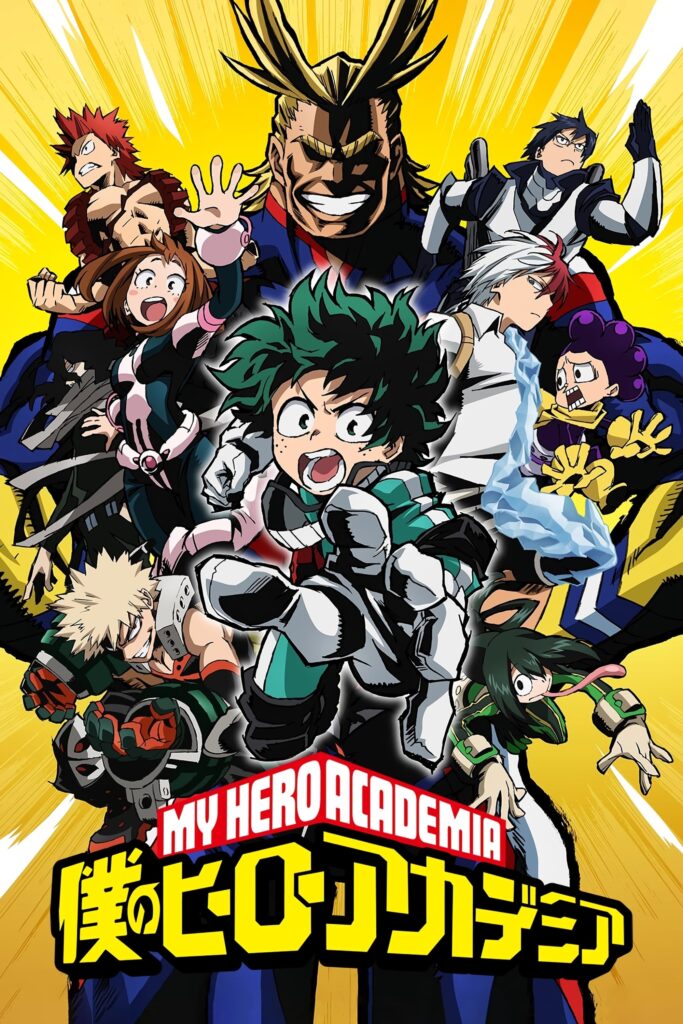
My Hero Academia has a colorful, expressive art style that fits its superhero setting.
The character designs are distinctive, allowing viewers to identify most members of the large cast quickly.
Hero costumes also play an important visual role.
Rather than giving every character a generic superhero uniform, the costumes are designed around their abilities and personalities. This helps each character feel visually different.
The action animation is one of the anime’s strongest technical features.
Quirks can produce very different visual effects, so fights do not all look identical. Explosions, physical attacks, speed-based movement, energy effects, and unusual abilities can all be animated differently.
The visual presentation also supports the emotional side of the story.
When a character becomes frightened, excited, determined, or overwhelmed, facial expressions and body language communicate those emotions clearly.
This is especially important for Izuku because much of his early development involves internal uncertainty.
His expressions often reveal his emotions before he can properly explain them.
The art style also handles comedy well.
Characters can be drawn with exaggerated expressions during lighter moments, allowing the anime to switch naturally between serious superhero drama and school comedy.
This balance prevents the series from becoming visually monotonous.
Music & Voice Acting
Music is another important part of My Hero Academia’s identity.
The soundtrack uses energetic compositions during action scenes while also providing emotional themes for character-focused moments.
Heroic music is particularly effective when the series wants to make a character’s actions feel inspiring.
At other times, the soundtrack becomes more restrained, allowing dialogue and atmosphere to carry the scene.
The voice performances also contribute significantly to the characters’ identities.
Daiki Yamashita voices Izuku Midoriya in the Japanese version, while Kenta Miyake voices All Might.
Izuku’s voice performance needs to communicate several different sides of the character. He can be nervous and uncertain in one scene, excited about heroes in another, and intensely determined when someone needs help.
All Might requires an equally broad performance.
His public persona is loud, confident, and larger than life, while his quieter moments reveal a more vulnerable side.
The contrast between these performances helps make their relationship convincing.
Strengths
Strong Main Character
Izuku’s personality gives the story an emotional center.
He is not perfect, and he is not immediately powerful. His willingness to learn and his instinct to help others make his progress rewarding.
Creative Superpower System
The Quirk system provides endless possibilities for character design and action.
Abilities are not simply decorative. They influence how characters train, fight, cooperate, and solve problems.
Memorable Supporting Cast
Even within a large class, many characters have distinct personalities and visual identities.
The students do not all behave the same way, which makes their interactions entertaining.
Good Balance of Genres
My Hero Academia combines action, comedy, school life, friendship, and drama.
The different elements generally support one another rather than making the story feel fragmented.
Accessible World-Building
The basic concept is explained naturally through the characters.
Viewers can understand the world without having to memorize complicated terminology or historical events.
Strong Heroic Themes
The anime consistently emphasizes courage, responsibility, compassion, and perseverance.
These themes give the action greater meaning.
Weaknesses
Some Familiar Shonen Elements
My Hero Academia uses several ideas that are common in shonen anime.
There is a talented rival, a school for gifted students, training, competition, powerful mentors, and characters learning to control their abilities.
These elements are not necessarily bad, but viewers who want a completely unconventional story may find parts of the setup familiar.
Large Cast
The class contains many students, and not everyone can receive equal attention immediately.
This can make certain characters feel less developed during the early episodes.
However, the large cast also gives the story plenty of possibilities for later character development.
Izuku’s Early Control Issues
Izuku’s transition from being powerless to handling extraordinary abilities is not instant.
He struggles to control his strength and must learn how to avoid seriously injuring himself.
Some viewers may find this frustrating, but it is also an important part of making his progression believable.
Slow Introduction
The early episodes spend considerable time establishing the world and characters.
Viewers expecting constant action from the beginning may find the introductory material slower.
The advantage is that the foundation becomes easier to understand once the larger conflicts begin.
What Makes the Story Different From a Typical Superhero Series?
My Hero Academia clearly takes inspiration from superhero fiction, but it combines that concept with the structure of a Japanese school-based shonen series.
That combination is one of its defining characteristics.
Instead of following established adult superheroes exclusively, the story focuses heavily on teenagers who are still learning.
They are not finished heroes.
They are students.
That distinction creates many interesting situations.
A student may have an incredible Quirk but poor judgment.
Another may have a less destructive ability but excellent tactical thinking.
Someone else may be brave but lack experience.
The school environment gives these differences room to develop.
It also makes friendships and rivalries central to the story.
Characters are not simply fighting because the plot needs a battle. They are competing because they want to become better heroes, prove themselves, or understand their own limitations.
This makes the series feel like a coming-of-age story wrapped inside a superhero adventure.
The Importance of U.A. High School
U.A. High School is more than just the location where Izuku attends classes.
It represents his entry into the world he has always admired.
Before U.A., Izuku is largely an observer.
He watches heroes on television.
He studies their abilities.
He dreams about becoming one.
At U.A., he finally gets the opportunity to participate.
The school also introduces him to people who challenge his assumptions.
Some classmates are naturally talented.
Others are highly disciplined.
Some are confident.
Others are nervous.
Their different personalities create an environment where Izuku can learn from people his own age rather than relying only on All Might.
The teachers are equally important.
They understand that hero training cannot be treated as ordinary education.
Students are preparing for situations where civilians may depend on them.
As a result, the training exercises often carry more weight than typical school assignments.
Heroism and Personal Responsibility
One of the most important themes in My Hero Academia is responsibility.
Having a powerful Quirk can make someone dangerous.
That means heroes must understand how to use their abilities safely.
A destructive power can save lives in one situation and endanger civilians in another.
The anime therefore emphasizes control.
This is particularly important for Izuku.
His new abilities give him access to power that he has never possessed before. Learning how to use that power responsibly becomes part of his development.
The story also distinguishes between being admired and being heroic.
Professional heroes are celebrities, but popularity alone does not make someone a good hero.
The deeper question is whether a person can remain dependable when things become frightening.
That idea is reflected in the characters’ different motivations.
Some want fame.
Some want financial security.
Some want to follow family expectations.
Some simply want to help people.
The series allows these motivations to coexist.
Rivalry Between Izuku and Bakugo
Izuku and Bakugo’s relationship is one of the strongest character dynamics in the story.
They grew up knowing each other, but their personalities and circumstances developed in very different directions.
Bakugo has always been confident in his abilities.
Izuku has always been more hesitant.
Their relationship becomes even more complicated once Izuku begins moving toward the hero career that Bakugo believes belongs to talented people like himself.
Their rivalry creates an interesting contrast.
Bakugo represents natural confidence and aggressive ambition.
Izuku represents careful observation, determination, and gradual growth.
Neither character is simply a perfect opposite of the other.
Their rivalry also helps push both of them forward.
For Izuku, Bakugo is a reminder of the gap between his current abilities and the level he wants to reach.
For Bakugo, Izuku becomes someone he cannot simply dismiss.
The Role of All Might
All Might is more than Izuku’s mentor.
He represents the ideal that Izuku has spent his entire childhood admiring.
To Izuku, All Might is proof that a hero can appear when people are frightened and make them feel safe.
That image is incredibly important to him.
At the same time, All Might’s role as a mentor introduces a more personal side to the character.
He has responsibilities beyond simply defeating villains.
He must teach someone else.
He must understand Izuku’s limitations.
He must help him grow without expecting him to become a copy of himself.
Their relationship therefore becomes one of the emotional foundations of the story.
The Importance of Character Development
My Hero Academia does not treat character development as something that happens only between major battles.
Students learn through classroom exercises, conversations, mistakes, competition, and everyday interactions.
This makes the U.A. environment feel more alive.
Izuku’s development is the clearest example.
He starts as someone who understands heroes academically but has no practical experience.
As he begins training, he discovers that knowing what a hero should do and physically being capable of doing it are very different things.
He must develop confidence.
He must learn to control his abilities.
He must understand teamwork.
Most importantly, he must learn that courage does not mean being fearless.
A hero can be afraid and still choose to act.
That idea is one of the strongest messages established by the early story.
Who Should Watch This Anime?
My Hero Academia is a strong recommendation for several types of anime viewers.
Fans of Shonen Anime
If you enjoy series built around training, rivalry, friendship, personal growth, and action, My Hero Academia is an easy choice.
Its structure will feel familiar to experienced shonen viewers while remaining accessible to newcomers.
Superhero Fans
The series offers a Japanese interpretation of the superhero genre.
It includes hero costumes, powers, villains, rescue operations, public rankings, and larger-than-life characters.
Fans of superhero comics and movies may especially enjoy seeing these ideas combined with anime storytelling.
Beginners
My Hero Academia can work well as a beginner-friendly anime.
The premise is straightforward, the characters are easy to distinguish, and the world-building is introduced through the story rather than through large amounts of exposition.
Fans of School Anime
Although the series contains serious action, U.A. is still a school.
Students attend classes, interact with one another, train, compete, and develop friendships.
This gives the anime some of the familiar appeal of school-based series.
Viewers Who Enjoy Character Growth
If you prefer protagonists who gradually improve rather than starting at their maximum potential, Izuku’s journey is one of the main reasons to watch.
His progress is tied to effort, training, mistakes, and experience.
Is My Hero Academia Worth Watching?
Yes, especially if you enjoy action anime with strong character development.
The series has a simple premise but uses that premise to explore more meaningful ideas about heroism.
Izuku’s starting position is particularly effective.
He wants to become a hero despite lacking the ability that society associates with heroes.
That creates an immediate emotional conflict.
When he finally gets an opportunity to move toward his dream, the story does not treat that opportunity as an instant solution.
Instead, he must work for it.
He has to train.
He has to learn.
He has to make mistakes.
He has to understand the consequences of his actions.
This makes the journey feel earned.
The supporting characters also keep the story interesting.
Bakugo provides rivalry and tension.
Ochaco adds warmth and friendship.
Iida represents discipline and responsibility.
Aizawa provides a practical perspective on hero training.
All Might represents the ideal of heroic inspiration.
Together, these characters create a world that feels larger than Izuku alone.
Final Verdict
My Hero Academia is a well-crafted superhero shonen anime with a strong central character, an imaginative Quirk system, memorable supporting characters, energetic action, and meaningful themes about courage and responsibility.
Its biggest strength is the way it combines familiar superhero concepts with a school-based coming-of-age story.
Izuku Midoriya’s journey begins with an enormous disadvantage. He is born without a Quirk in a society where supernatural abilities are common, yet he refuses to abandon his dream of becoming a hero.
His determination eventually opens the door to U.A. High School, where he begins learning what professional heroism actually requires.
The anime’s 13-episode opening run provides a clear introduction to the world, the characters, the Quirk system, and the central themes. Bones’ animation gives the series a colorful visual identity, while the soundtrack and voice performances add energy and emotion to important scenes. The official production information confirms the 2016 broadcast period and Bones’ role in the adaptation.
There are familiar shonen elements, and the large cast means not every character receives equal attention immediately. The early story can also feel slower for viewers expecting nonstop action.
Still, those limitations are outweighed by the series’ strengths.
The world is easy to understand.
The characters are memorable.
The Quirks create creative possibilities for action.
The school setting supports character development.
And the story has a clear emotional message: being a hero is not simply about having power. It is about choosing to help others when it matters.
For anyone looking for a beginner-friendly superhero anime with action, comedy, friendship, rivalry, and character growth, My Hero Academia is an excellent choice.