
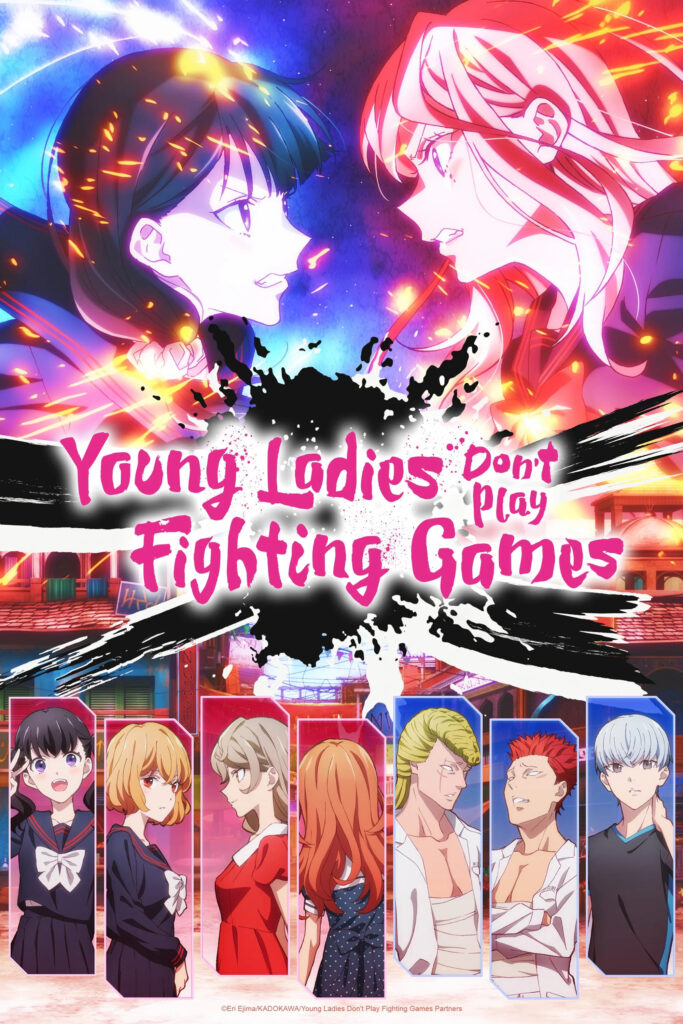
Young Ladies Don’t Play Fighting Games
Introduction
The funniest thing about Young Ladies Don’t Play Fighting Games is that the girls aren’t secretly playing video games because they’re rebellious teenagers.
They’re playing because they genuinely love fighting games.
Aya Mitsuki arrives at Kuromi Girls’ Academy hoping to become the kind of elegant young lady represented by Mio Yorue, the school’s almost impossibly polished “White Lily.” Then Aya discovers Mio alone, completely abandoning her refined image while playing a fighting game.
Within minutes, the perfect school idol turns into a competitive gamer who wants another match.
That’s the basic joke, but it isn’t the whole appeal.
Once the series gets serious about fighting games, it starts dealing with things players actually recognize: character mains, matchup problems, balance patches, practice, tournament nerves, losing streaks and the difference between playing to win and playing because you simply enjoy the game.
That makes Young Ladies Don’t Play Fighting Games considerably more specific than its title suggests.
Overview
At Kuromi Girls’ Academy, being elegant isn’t just encouraged. It’s practically part of the school’s identity.
Aya is a scholarship student who wants to fit into that environment. She admires Mio, one of the school’s most admired students, and sees her as the perfect example of the refined person Aya wants to become.
Then she discovers Mio’s secret.
Mio is a fighting-game obsessive.
Worse, she isn’t casually playing for a few minutes after school. She understands the competitive side of the game and immediately recognizes that Aya knows how to play too.
The two begin secretly playing together despite gaming being forbidden at school.
That setup creates two very different kinds of comedy. There’s the obvious contrast between their elegant school personas and the way they behave during matches, but there’s also the comedy of competitive gaming itself.
Someone can look completely composed in class and then spend ten minutes furious because their main character got nerfed.
That contrast becomes the foundation for the series.
The anime also uses Street Fighter 6 rather than leaving its fighting game entirely fictional, giving the matches a much more recognizable foundation for players familiar with modern fighting games.
Story Summary: What Kind of Anime Is It?
The first few episodes are primarily about Aya and Mio discovering that they have found the one person who understands their obsession.
Episode 1 establishes the central secret. Aya discovers Mio playing and gets pulled into a match.
Episode 2 immediately turns that first encounter into unfinished business. Aya and Mio want a rematch, but they also have to avoid getting caught playing at school.
Episode 3 introduces another important part of their routine: finding somewhere they can actually play without the school’s rules getting in the way.
By Episode 4, the series begins mixing gaming with ordinary school responsibilities. Mio’s enthusiasm for fighting games starts colliding with exams, creating one of the show’s better recurring jokes: competitive gaming may be important, but the school still expects these girls to behave like model students.
Then the story expands.
The girls decide to enter a tournament in Tokyo, and the series begins shifting from “two girls secretly play fighting games” toward an actual competitive story.
Episode 6 is particularly important because a balance patch changes the competitive environment. Aya’s main gets nerfed while Mio’s gets buffed, forcing Mio to work on a new technique rather than simply relying on what worked previously.
By Episodes 7 and 8, tournament pressure becomes the focus.
That’s where the series becomes more than a school comedy.
The girls have to deal with players who are simply better than them, and losing stops being an abstract possibility.
Main Characters
Aya Mitsuki
Aya is the easiest character to understand because her original motivation isn’t gaming.
She wants to become a refined young lady.
That makes her transformation into someone who becomes increasingly serious about fighting games funnier than it would be if she started as a hardcore gamer.
Aya also has a competitive streak that becomes increasingly difficult for her to hide.
Ikumi Hasegawa’s performance is important here because Aya has to move between two personalities: the polite student she wants everyone to see and the much more emotionally explosive player who appears once a match begins.
Mio Yorue
Mio is the character who sells the entire premise.
At school, she is the elegant “White Lily.”
Behind closed doors, she is a serious fighting-game player.
The interesting part isn’t simply that she has a secret hobby. It’s how completely different her emotional state can become during a match.
Mio doesn’t treat fighting games as a cute little pastime.
She wants to win.
Kana Ichinose gives her the right combination of composure and competitive intensity.
Yuu Inui
Yuu provides another perspective on the girls’ obsession and becomes increasingly important once the group starts expanding beyond Aya and Mio.
She helps the show avoid becoming entirely dependent on the same two-character joke.
Her presence also makes the gaming group feel more like a community rather than a private rivalry between two students.
Sayaka Senbongi voices Yuu.
Tamaki Ichinose
Tamaki adds another layer to the school’s social dynamics.
She isn’t simply there to increase the number of characters around the gaming group. Her relationship with the others gives the story more opportunities to show how different personalities react to competitive play.
Shino Shimoji provides her Japanese voice.
Arisa Fujimiya
Arisa becomes particularly important once the story reaches the tournament material.
Her match against Mio in the final episode gives the season a much more serious competitive atmosphere than the early episodes suggest.
Maria Naganawa voices Arisa.
Why You Should Watch Young Ladies Don’t Play Fighting Games
The best reason is simple: the anime understands that fighting games are more interesting when losing matters.
A weaker version of this show would have Aya and Mio constantly win because the joke is supposed to be that elegant girls secretly play violent games.
This anime is more willing to let them struggle.
Episode 6’s balance-patch storyline is a good example.
A character becoming stronger because the writers need her to win would be boring. Instead, the anime uses an actual competitive-game problem: a patch changes the balance, which forces players to reconsider what they know.
That gives the girls’ improvement a practical reason.
The tournament episodes push this further.
By Episode 8, Aya and Mio are facing experienced players and discovering that enthusiasm doesn’t automatically make someone good enough to win.
That is where the anime’s competitive side becomes genuinely satisfying.
Animation & Art Style
Diomedéa handles the animation, with Shota Ihata directing, Wataru Watari supervising series composition, Mayuko Matsumoto designing the characters and Kana Hashiguchi composing the music. The production also received fighting-game recording cooperation from FAV gaming.
The most important animation decision was using Street Fighter 6 as the basis for the game’s footage rather than inventing every fighting-game interaction from scratch.
That gives the matches an immediately recognizable visual language.
A character’s movement isn’t just generic anime punching. Players familiar with Street Fighter 6 can recognize the underlying game logic.
The production is strongest during these match sequences.
The character acting outside the games is more conventional. The girls’ elegant school uniforms and polished academy surroundings create a deliberately restrained visual contrast with the much more aggressive fighting-game sequences.
That contrast is important because the anime wants you to feel the difference between the girls’ public identities and their actual personalities.
It isn’t a show built around spectacular animation every week.
Its visual strength is contrast and game presentation, not constant sakuga fireworks.
Music & Voice Acting
The voice cast is one of the anime’s strongest assets.
Ikumi Hasegawa as Aya and Kana Ichinose as Mio need to sell both sides of their characters: the refined school versions and the much more emotionally unstable versions that emerge during games.
Sayaka Senbongi, Shino Shimoji and Maria Naganawa round out the core cast.
Kana Hashiguchi composed the score.
The opening theme, “Inochi Mijikashi Taisuru Otome yo,” is performed by Hanabie., while halca performs the ending theme “NEW GAME.”
“NEW GAME” is particularly appropriate for the series because the song’s upbeat tone matches the show’s more playful side.
But the voice acting is what carries the comedy.
The funniest moments aren’t necessarily punchlines.
They’re moments where a character who has spent the entire day acting like a perfect young lady suddenly sounds absolutely furious because of something that happened in a fighting game.
The Anime Actually Gets Fighting-Game Culture
This is the section I think separates Young Ladies Don’t Play Fighting Games from the average “girls play video games” anime.
The series isn’t satisfied with using fighting games as a visual gimmick.
It understands several things that are fundamental to competitive fighters.
First, your main character matters.
Players don’t simply choose whoever looks coolest. They develop habits, match-up knowledge and muscle memory around specific characters.
Then a balance patch arrives.
Suddenly, something that worked yesterday doesn’t work the same way today.
That’s exactly what Episode 6 uses for its story. Aya’s main gets nerfed while Mio’s gets buffed, and Mio has to adapt by learning a new technique.
That might sound like a small detail to someone who doesn’t play fighting games.
To a competitive player, it’s familiar.
The anime also understands the difference between practice and performance.
You can perform a technique perfectly in training mode and still fail to execute it under tournament pressure.
You can understand a matchup theoretically and then completely freeze when an actual opponent starts doing something unexpected.
And you can lose a match despite playing well.
Those are the details that make the competitive portions believable.
The show isn’t trying to teach viewers how to play Street Fighter 6.
It’s using the structure of fighting-game competition to explain its characters.
That is a much smarter use of the setting.
Why the “Elegant Girls” Gimmick Doesn’t Get Old Immediately
The obvious joke is that these girls are supposed to behave like refined aristocrats but become completely different people while playing fighting games.
The reason it survives beyond the first episode is that the contradiction keeps producing new situations.
Mio’s reputation makes her gaming secret more embarrassing.
Aya’s desire to become elegant conflicts with her competitive instincts.
School rules turn ordinary gaming sessions into covert operations.
Exams become obstacles to practice.
A tournament transforms their private hobby into something other people can watch.
Then losing introduces an entirely different emotional problem.
The girls can’t simply hide behind the joke anymore.
They care about the result.
That progression is important.
If the anime had stayed entirely inside the “secret gaming after school” setup, it would probably become repetitive.
Instead, it gradually increases the consequences of playing.
By the final episodes, the fighting game isn’t just the punchline.
It’s the thing through which the characters measure themselves.
Young Ladies Don’t Play Fighting Games vs Hi Score Girl
If you’re choosing between this and Hi Score Girl, I would recommend Hi Score Girl for someone who wants a stronger historical story about gaming culture.
Hi Score Girl is deeply interested in arcade history, the development of fighting games and the culture surrounding games in the 1990s.
Young Ladies Don’t Play Fighting Games is much more focused.
Its subject is competitive fighting games themselves.
It cares less about gaming history and more about what happens when people become obsessed with getting better.
The character dynamics are also different.
Hi Score Girl uses gaming as part of a coming-of-age romance.
Young Ladies Don’t Play Fighting Games uses gaming as the central relationship language between its characters.
So:
Choose Hi Score Girl if you want retro gaming history, romance and nostalgia.
Choose Young Ladies Don’t Play Fighting Games if you want modern competitive fighters, tournament tension and girls screaming at each other over matches.
Neither replaces the other.
Young Ladies Don’t Play Fighting Games vs New Game!
The titles make the comparison inevitable, but the shows are very different.
New Game! is about women working in the video-game industry.
This anime is about people playing games.
That difference matters.
New Game! spends much more time on workplace relationships, development and the process of making games.
Young Ladies Don’t Play Fighting Games is interested in the player’s side.
The controller is in their hands.
The frustration belongs to them.
The victory belongs to them.
If you want a relaxing workplace slice-of-life, choose New Game!.
If you want competitive gaming and actual match pressure, choose Young Ladies Don’t Play Fighting Games.
Where to Watch Young Ladies Don’t Play Fighting Games
The easiest international option is Crunchyroll.
Crunchyroll announced the series for worldwide streaming outside Japan and China, with its international premiere scheduled for July 7, 2026.
The Crunchyroll catalog currently lists Japanese and Thai audio, with English and numerous other subtitle options. It does not currently list an English dub for the series.
That is worth knowing because some third-party listings loosely label the series as “sub and dub,” but the official Crunchyroll audio listing currently shows Japanese and Thai, not English.
For Indian viewers, the series is also listed on Sony LIV, where Season 1 is shown as 12 episodes.
The Japanese broadcast began on July 7, 2026, while international streaming followed the same day through Crunchyroll. The Japanese domestic schedule included AT-X, Tokyo MX, BS NTV and MBS, while U-NEXT, Anime Hodai and d Anime Store received the earliest Japanese streaming window.
Season 1 has now finished, with Episode 12 released in September 2026.
Manga vs Anime: Should You Read the Manga?
Yes, especially if the competitive side of the series is what interests you.
The anime is based on Eri Ejima’s manga, which has been serialized in Monthly Comic Flapper since 2020. The manga is still an ongoing source of material, so the anime only represents a portion of the larger story.
The adaptation is generally faithful through much of its first season, but it does make changes.
One especially important difference is how the anime handles the fighting-game material.
The manga originally used a fictional game called Iron Senpai 4. The anime instead incorporates Street Fighter 6, giving the adaptation a real commercial fighting game to build its match footage around.
That is a meaningful adaptation choice rather than a cosmetic one.
Real characters, animations and game mechanics make the matches much easier for viewers to recognize.
The anime’s Episode 12 also diverges from the manga’s subsequent material after the tournament, so manga readers shouldn’t assume the next chapter simply continues from the anime’s final scene without changes.
If you want more of the story after Season 1, the manga is therefore the better route.
Strengths
- The fighting-game material is unusually specific.
- Aya and Mio have a genuinely funny contrast between their public and gaming personalities.
- Balance patches and matchup problems give the competition believable stakes.
- The tournament arc prevents the series from becoming repetitive school comedy.
- Street Fighter 6 gives the matches a recognizable foundation.
- The voice performances sell the characters’ emotional swings.
- The anime understands that losing can be more interesting than winning.
- The central friendship develops through competition rather than generic bonding scenes.
Weaknesses
The biggest weakness is that the anime sometimes assumes that viewers will already understand why a fighting-game detail matters.
A balance patch is fascinating to a player who understands mains and matchups.
For someone who has never touched a fighting game, “Aya’s character got nerfed” can simply sound like technical jargon.
The show could occasionally do more to translate those competitive ideas into dramatic stakes for non-players.
There is also a structural issue with the first season.
The early episodes are strongest as a two-person comedy. The later tournament material is stronger as a competitive drama.
Both work, but the transition between them isn’t completely seamless.
And while the animation handles the game footage effectively, viewers looking for consistently spectacular animation shouldn’t expect every match to look like a blockbuster action sequence.
Who Should Watch This Anime?
Watch it if you enjoy fighting games or competitive gaming and want an anime that actually treats the hobby seriously.
You should especially try it if you like:
- Street Fighter
- Hi Score Girl
- competitive gaming stories
- school comedies with an unusual central hobby
- character-driven rivalry
- tournament arcs
- anime girls with extremely competitive personalities
- comedy that comes from characters taking something ridiculous very seriously
You don’t need to be a fighting-game expert.
But if you’ve ever lost a match and immediately thought, “One more game,” you’ll probably understand these characters faster than most viewers.
Who Should Skip This Anime?
Skip it if you have zero interest in fighting games and don’t enjoy watching characters discuss game mechanics.
The show is not merely using gaming as background decoration.
The matches become increasingly important to the plot.
You should also skip it if you want a purely relaxing slice-of-life series.
There are plenty of funny school moments, but tournament pressure, rivalry and losing become increasingly important as the season progresses.
Final Verdict
Young Ladies Don’t Play Fighting Games is much more specific than its title makes it sound.
The elegant-schoolgirl setup gets your attention, but the fighting-game details are what keep the series interesting.
Aya and Mio aren’t playing games because the anime needs a quirky hobby for its characters.
They actually care about winning.
They care about their characters.
They care about balance changes.
They care about tournaments.
And eventually, they have to deal with the uncomfortable reality that someone can love a game and still be terrible at it.
That’s where the show finds its best material.
The animation isn’t consistently spectacular, and newcomers to fighting games may occasionally feel lost when the characters start talking about mechanics. But for viewers who understand competitive gaming, those details are exactly what prevent the series from becoming another generic school comedy.
My verdict: 8/10.
If you’re a fighting-game player, I’d recommend it without much hesitation.
If you’re not, give it two or three episodes.
If Aya and Mio’s secret matches don’t make you want to play “just one more round,” the anime probably isn’t going to convert you later.