
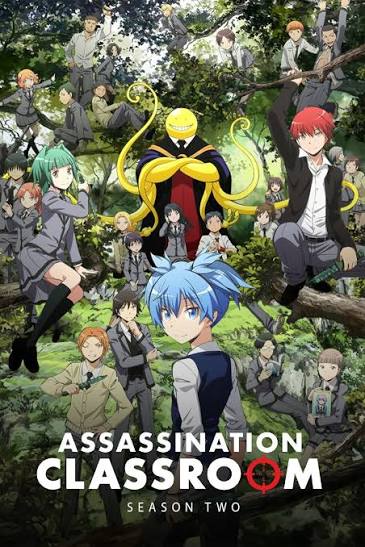
Assassination Classroom Second Season
Introduction
There is a strange moment in Assassination Classroom Season 2 when the premise stops being funny.
For most of the first season, watching a classroom full of teenagers try to assassinate their yellow octopus teacher is ridiculous in exactly the right way. Koro-sensei dodges bullets, teaches mathematics, takes his students on trips and somehow manages to be both the world’s most wanted creature and the teacher who cares most about Class 3-E.
Season 2 keeps the comedy, but it starts taking the deadline seriously.
The students are getting closer to graduation. Their assassination skills have improved. Koro-sensei knows that some of them are genuinely capable of killing him.
And underneath all those colorful classroom episodes is a question the series can no longer avoid:
What happens when the students actually have to choose whether Koro-sensei should die?
That is where Season 2 becomes much more than a continuation.
It is the payoff to everything the first season built.
Overview
Assassination Classroom Season 2 picks up with Class 3-E continuing its attempt to assassinate Koro-sensei before graduation.
The basic premise remains familiar, but the purpose of the story changes.
Season 1 is largely about turning a group of neglected students into a functioning class. Season 2 takes those students and asks what they will do with the skills, confidence and relationships they have developed.
The official production returned with Lerche handling animation, Seiji Kishi directing and Makoto Uezu overseeing series composition and scripts. Naoki Sato continued as composer.
The second season premiered in Japan on January 7, 2016, and ran weekly until June 30, 2016.
What makes Season 2 different is that the students are no longer asking, “Can we kill Koro-sensei?”
They have already learned that they can.
The harder question becomes:
Should they?
That shift gives almost every major character storyline more weight.
Story Summary: What Is Season 2 About?
Season 2 continues Class 3-E’s strange final school year, but the story gradually moves away from the simple teacher-versus-students setup.
The students still plan assassination attempts, compete with each other and get dragged into absurd school situations. Koro-sensei is still capable of turning an ordinary lesson into something completely ridiculous.
But the season increasingly explores what Koro-sensei has actually meant to these students.
That becomes important because their relationship with him is no longer one-sided.
At the beginning of the series, Koro-sensei is their target.
By Season 2, he is also their teacher, mentor, protector and the person who has helped many of them become more confident.
The season gives several students their own moments instead of treating Class 3-E as one large group.
Nagisa’s natural ability for assassination becomes a serious issue rather than just a funny talent. Karma has to confront what his intelligence and aggression actually mean when the stakes become personal. Other students receive smaller arcs that demonstrate how much they have changed.
The season also introduces the Reaper storyline, which provides one of its most action-heavy stretches.
But the most important material comes later.
As graduation approaches, the students are forced to confront the fact that their bizarre school year has an expiration date.
The final stretch is therefore less interested in asking whether Koro-sensei can be killed and more interested in asking whether killing him is really the outcome everyone wants.
That is why the final episodes hit harder than the early premise would suggest.
Main Characters
Koro-sensei
Season 2 is where Koro-sensei’s character changes from “the funny alien teacher” into the emotional center of the entire story.
The trick is that the anime never completely abandons his ridiculous side.
He can still behave like an overexcited teacher, complain about his students and turn ordinary classroom activities into elaborate productions.
But now the audience understands that his relationship with Class 3-E has an expiration date.
That changes the meaning of his behavior.
A joke that would have been harmless in Season 1 can suddenly feel bittersweet because you know these students will eventually leave him.
Koro-sensei’s greatest strength as a character is that he doesn’t simply tell his students to become better people.
He teaches them how to recognize what they are good at.
Nagisa Shiota
Nagisa receives one of Season 2’s most important character developments.
His calm personality has always hidden an unusual talent for assassination.
In the second season, that talent becomes impossible for him to ignore.
The “Round Two Time” storyline is particularly important because Nagisa has to confront what his ability actually says about him and what other people want to do with that ability. Crunchyroll’s episode description specifically frames the story around Nagisa struggling with his talent while his mother has her own plans for his future.
Nagisa’s arc works because the question isn’t simply whether he is strong.
It is whether he gets to decide what kind of person he wants to become.
Karma Akabane
Karma remains one of the most naturally entertaining students in the class.
He is intelligent, confident and considerably more aggressive than Nagisa.
But Season 2 gives him situations where raw intelligence isn’t enough.
His rivalry with Nagisa is particularly effective because the two characters have very different approaches to assassination. Karma is naturally confrontational; Nagisa is observant and patient.
Their differences become more meaningful as the series asks both of them to think about life after Class 3-E.
Karasuma
Karasuma is still the serious adult surrounded by complete chaos.
That contrast is part of his appeal.
He takes the assassination assignment seriously because he understands the danger Koro-sensei represents, but he also recognizes that the students have developed beyond the original purpose of their mission.
Season 2 gives him more opportunities to act as a genuine mentor rather than simply the government’s representative.
Irina Jelavic
Irina’s role continues to provide comedy, but Season 2 gives her relationship with Karasuma more room to develop.
The joke is often that Irina is a professional assassin who is somehow terrible at acting normal around the people she actually cares about.
But underneath the comedy is another example of the series’ central idea: people change when they become part of Class 3-E.
Irina isn’t simply teaching assassination anymore.
She is attached to the students and to the bizarre little community they have created.
Kaede Kayano
Kayano becomes especially important as the story approaches its final major conflict.
Her character is one of the clearest examples of why watching Season 2 without knowing the earlier episodes would be a mistake.
The series uses information established much earlier and recontextualizes it later.
What initially appears to be a simple personality trait becomes something much more significant.
Her storyline also tests one of Koro-sensei’s most important lessons: understanding someone’s pain doesn’t necessarily mean you can prevent them from making destructive choices.
Why You Should Watch Season 2
The easiest reason to watch Season 2 is simple:
It actually pays off the premise.
A lot of anime can create an excellent setup and then struggle when it is time to deliver the conclusion.
Assassination Classroom doesn’t have that problem to the same extent.
The students become better assassins.
Their relationships change.
Koro-sensei’s past becomes important.
The government becomes increasingly concerned about what will happen.
And eventually, the central assassination mission stops being a joke.
Episode 5, “Leader Time,” is a good example of the series using the assassination premise to explore the students rather than simply staging another attempt to kill Koro-sensei. The episode puts Class 3-E against the elite Class A during the school sports festival while Isogai faces pressure involving his family’s financial situation.
Then the Reaper storyline gives the season a burst of action before the series turns back toward its characters.
That mixture is what makes Season 2 work.
It can be ridiculous for ten minutes and unexpectedly serious five minutes later.
Animation & Art Style
Lerche’s animation style fits Assassination Classroom unusually well because the series needs to jump between comedy, action and emotional drama without making the transitions feel completely disconnected.
Koro-sensei himself is visually simple.
That is an advantage.
His exaggerated facial expressions allow the anime to turn him into a comedy character instantly, while the more serious scenes can strip away that silliness and make his character feel surprisingly vulnerable.
The action episodes also benefit from clearer choreography than the average school comedy.
The Reaper arc, particularly Episodes 7 and 8, gives the production a chance to use movement, weapons and combat rather than relying entirely on classroom comedy. Crunchyroll’s episode listing confirms the two-part Reaper storyline.
But the strongest visual moments aren’t necessarily the action scenes.
The anime is particularly effective when it uses quiet framing during the later episodes.
As graduation approaches, the classroom itself becomes emotionally important.
It isn’t just where the students happen to study.
It is the place where their entire relationship with Koro-sensei happened.
The production understands that.
Music & Voice Acting
Naoki Sato’s music is an important part of the show’s ability to move between comedy and drama.
The soundtrack doesn’t try to make every emotional scene overwhelmingly dramatic. Instead, it often allows the situation to develop before pushing the emotion.
Jun Fukuyama’s performance as Koro-sensei is the biggest reason the character works as well as he does.
Koro-sensei needs an enormous vocal range.
He has to sound ridiculous when he is panicking about his students, theatrical when he is showing off, threatening when the situation becomes serious and genuinely emotional during the final stretch.
Fukuyama handles all of those sides without making the character feel like several different personalities.
The rest of the cast is equally important because Koro-sensei only works emotionally if the students sound like people who have genuinely become attached to him.
The official cast includes Nobuhiko Okamoto as Karma, Mai Fuchigami as Nagisa, Ayaka Suwa as Kaede Kayano, Tomokazu Sugita as Karasuma and Shizuka Ito as Irina.
Where To Watch Assassination Classroom Season 2
Crunchyroll currently lists Assassination Classroom with both subtitles and dubs, and its Season 2 episode pages include English audio alongside Japanese and other language tracks.
For example, the Season 2 finale, “Graduation Time,” is available on Crunchyroll with Japanese and English audio, as well as Latin American Spanish and Brazilian Portuguese.
Availability can vary by country, so the platform’s regional catalog should be checked before assuming a particular dub or subtitle language is available.
For viewers in India, current streaming listings show Season 2 on Crunchyroll, including 25 episodes. JustWatch also lists Crunchyroll and Crunchyroll Amazon Channel availability in India.
The original Japanese broadcast ran weekly from January 7, 2016, through June 30, 2016.
Unlike a currently airing anime, you don’t have to follow a weekly schedule now. The complete season is available to stream where licensed.
Assassination Classroom Season 2 vs Season 1
This is one of those rare cases where choosing a favorite depends on what you value.
Season 1 is funnier.
It has the advantage of introducing the absurd concept and watching Class 3-E slowly figure out what kind of teacher Koro-sensei actually is.
The assassination attempts feel fresh because nobody knows what to expect.
Season 2 is more important.
It takes the relationships established in Season 1 and gives them consequences.
The students aren’t simply getting better grades and better assassination techniques. They are becoming people who have to make decisions about their future.
Season 2 also spends much more time on Koro-sensei himself.
The result is less episodic and more emotionally connected.
If you loved the comedy above everything else, you may prefer Season 1.
If you want the story to actually resolve its central premise, Season 2 is clearly stronger.
My choice: Season 2 is the better season, while Season 1 is the easier season to binge casually.
Assassination Classroom vs My Hero Academia
The comparison sounds strange until you look at what both series do with students.
My Hero Academia is about students learning to become heroes in a world built around superpowers.
Assassination Classroom is about students who are initially treated as failures and learn to understand their individual abilities.
The difference is scale.
My Hero Academia focuses on superhero society, battles and long-term conflicts.
Assassination Classroom stays much more intimate.
The students’ victories aren’t usually about defeating the strongest opponent.
They are about realizing that something they thought was a weakness can become useful.
If you want large-scale battles and superhero progression, pick My Hero Academia.
If you want a smaller cast with a stronger emphasis on classroom relationships and character closure, I prefer Assassination Classroom.
Assassination Classroom vs Mob Psycho 100
This is a closer comparison emotionally.
Both series use comedy to hide surprisingly serious character writing.
Both also feature protagonists who are more complicated than their absurd surroundings initially suggest.
But Mob Psycho 100 is more focused on personal identity and emotional growth, while Assassination Classroom is more focused on mentorship and the transition from childhood into adulthood.
The biggest difference is the ending.
Assassination Classroom is built around a deadline from its first episode.
That means the eventual ending isn’t an unexpected development.
The entire story is moving toward it.
If you want a supernatural action-comedy, choose Mob Psycho 100.
If you want a story where graduation genuinely changes everything, Assassination Classroom has the stronger fit.
Manga vs Anime: Is The Anime Faithful?
The anime is one of the better examples of a television adaptation actually reaching the intended ending.
The second season covers the manga’s remaining story rather than ending halfway through the material.
That matters enormously for this series because the entire premise depends on the March deadline.
A partial adaptation would have weakened the concept.
There are differences in pacing and some material is condensed, but the anime retains the major character arcs and central conclusion.
The original manga by Yusei Matsui is therefore best approached as an alternative way to experience the story rather than something you absolutely must read to understand the ending.
If you watched both seasons and loved the characters, reading the manga is still worthwhile because it gives you additional scenes and details.
But unlike some anime adaptations, you aren’t required to switch to the manga because the anime stops before the real ending.
The anime actually finishes the story.
That is a major advantage.
Strengths
- The season actually delivers on the central assassination premise.
- Koro-sensei becomes much more emotionally complex without losing his comedic personality.
- Nagisa and Karma receive meaningful development.
- The final stretch has genuine emotional weight because the graduation deadline has existed from the beginning.
- Individual students get enough attention to make Class 3-E feel like an actual group of people.
- The Reaper arc provides a useful change of pace.
- The anime balances comedy, action and drama better than the premise suggests.
- The ending gives the story closure instead of artificially extending the classroom setup.
Weaknesses
Season 2’s biggest weakness is also partly its ambition.
There are a lot of students.
The anime does a good job giving many of them moments, but not everyone receives enough development to feel equally important.
Some episodes can therefore feel like the series is checking in on another student because it knows graduation is approaching rather than because that particular subplot is essential to the main story.
The other problem is tonal.
The series can jump from absurd comedy to serious tragedy very quickly.
For some viewers, that is exactly why Assassination Classroom works.
For others, it can feel manipulative.
There are moments where the anime clearly wants you to become emotional, and you can sometimes see the emotional machinery operating underneath the scene.
I don’t think this ruins the story.
But it does mean the emotional impact isn’t as subtle as something like Frieren or March Comes in Like a Lion.
The show is comfortable telling you when something matters.
Who Should Watch Season 2?
Watch Season 2 if you finished the first season and want the story to actually reach its destination.
It is especially worth continuing if you became attached to Koro-sensei, Nagisa, Karma or the other members of Class 3-E.
Season 2 also works well for viewers who initially came for the comedy but ended up caring about the characters.
If you enjoy anime about teachers and students, character growth, school friendships or stories built around a fixed deadline, this season is one of the stronger examples of the format.
And if you were wondering whether the assassination premise eventually becomes serious:
Yes.
Very serious.
Who Should Skip Season 2?
Skip it only if the first season’s combination of comedy and school-life storytelling wasn’t your thing.
Season 2 doesn’t reinvent the formula completely.
It becomes more dramatic, but it remains Assassination Classroom.
You should also avoid starting with Season 2.
Too much of its emotional weight depends on relationships and events established during the first season.
Watching the second season alone would be like reading the final chapters of a character-driven novel and expecting the deaths and graduation scenes to have the same impact.
They won’t.
Final Verdict
Assassination Classroom Season 2 is where the series proves that its ridiculous premise wasn’t a gimmick.
The moon-destroying creature, the government assassination contract and the students’ ridiculous weapons are only the surface.
Underneath them is a story about a teacher who gets one year to change a group of students and a group of students who eventually have to decide what that teacher means to them.
The smartest choice the series makes is establishing the deadline from the beginning.
March is always coming.
Every funny classroom scene, every assassination attempt and every ridiculous school trip happens with that knowledge hanging over the story.
When Season 2 finally reaches graduation, the emotional impact comes less from surprise and more from accumulation.
You have watched these students change.
You have watched Koro-sensei teach them.
You know exactly what the original assignment requires.
And eventually, the class has to make its decision.
Season 2 isn’t perfect. Some side-character material is uneven, and the show can occasionally push its emotional buttons too obviously.
But it completes what it started.
Is Assassination Classroom Season 2 worth watching? Absolutely.
If you have finished Season 1, stopping here would mean missing the actual payoff.
My rating: 9/10