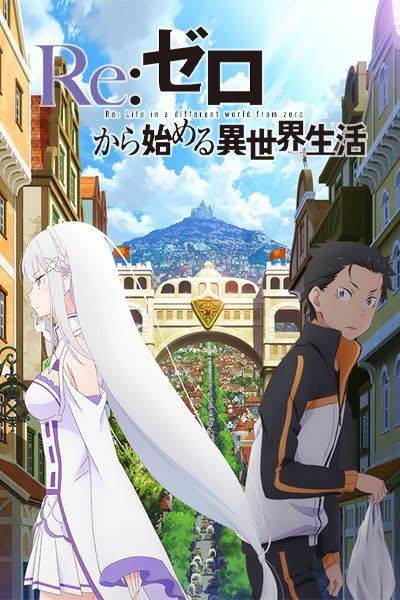
Re:ZERO -Starting Life in Another World
Introduction
Subaru Natsuki discovers that dying can send him back in time. In most fantasy anime, that would be an absurdly powerful ability. In Re:ZERO -Starting Life in Another World- Season 1, it becomes the reason he suffers through events that nobody else remembers.
Subaru arrives in a fantasy world expecting adventure, but his first encounters with danger quickly expose how little he understands about his new surroundings. He cannot overpower every enemy, predict every betrayal, or explain why he sometimes knows things that should be impossible. When something goes wrong, he may get another chance, but the people around him do not share his memories of what happened before.
That difference makes the first season much more interesting than a conventional reincarnation story. Its central question is not whether Subaru can become the strongest person in this world. It is whether he can survive its cruelty without losing his sense of self.
My verdict: Re:ZERO Season 1 is an excellent choice for viewers who enjoy psychological tension, mystery, flawed protagonists, and fantasy stories where victories have a genuine emotional cost.
Overview: What Is Re:ZERO Season 1 About?
Subaru Natsuki is suddenly transported from modern Japan to a world filled with magic, unfamiliar customs, and dangerous people. Shortly after arriving, he meets Emilia, a silver-haired half-elf who helps him when he finds himself in trouble. Subaru decides to assist her, but their encounter leads him into a mystery involving a stolen insignia and a series of deadly confrontations.
He soon discovers that death sends him back to an earlier point in time. He remembers previous events, but everyone else behaves as though those events never happened.
This ability, often described as returning through death, gives Subaru opportunities to change the outcome of situations. However, it does not provide him with a convenient instruction manual. He must work out what went wrong, identify whom he can trust, and figure out how to prevent the same tragedy from happening again.
What separates Re:ZERO from many isekai anime is the relationship between knowledge and power. Subaru can remember a disastrous encounter, but that does not automatically give him the physical ability, social influence, or emotional maturity needed to prevent it.
His memories become both an advantage and a burden. The more he learns, the more difficult it becomes to explain his behaviour to people who have no idea what he has experienced.
Story Summary (Spoiler-Free)
Season 1 begins with a relatively familiar fantasy setup before gradually turning into a psychological mystery. Subaru meets Emilia, encounters the inhabitants of a mansion, and becomes involved in events that are much more dangerous than they initially appear.
The season’s early episodes establish the rules of Subaru’s unusual ability while introducing the world and its important characters. Later, the story expands beyond immediate survival. Political tensions, personal loyalties, and supernatural threats complicate Subaru’s attempts to protect the people he cares about.
The pacing is deliberately uneven. Some episodes move quickly through confrontations and discoveries, while others spend considerable time on conversations, emotional breakdowns, and attempts to understand another person’s motives. Those slower stretches matter because Re:ZERO frequently makes Subaru’s emotional state as important as the external threat.
The series also shifts between fantasy adventure, horror, mystery, and character drama without completely abandoning any of them. A seemingly ordinary interaction can become unsettling once the viewer understands what Subaru remembers, while a successful outcome can feel uncomfortable because of the suffering required to reach it.
Season 1 adapts a substantial opening portion of the larger story rather than resolving every mystery surrounding Subaru and his world. Its ending provides a meaningful point of progress for the characters while leaving larger questions open for future seasons.
Main Characters
Subaru Natsuki: A Protagonist Who Cannot Simply Become Stronger
Subaru is the most important reason Re:ZERO works, but he is also the character most likely to frustrate viewers.
He arrives with the confidence of someone who expects to be the centre of a fantasy adventure. He jokes, makes assumptions, and sometimes treats the people around him as though their feelings should follow the script he has imagined for himself. His enthusiasm can be entertaining, but it also reveals his immaturity.
The series refuses to make these flaws disappear simply because Subaru is the protagonist. When he makes a poor decision, he has to confront its consequences. When he believes he understands someone, the story may reveal how little he actually knows.
His defining struggle is that remembering previous failures does not automatically make him wiser. He must learn to listen, admit weakness, and recognise that caring about somebody does not give him ownership over their choices.
Emilia: More Than Subaru’s Motivation
Emilia initially appears through Subaru’s idealised perspective. He is immediately drawn to her kindness and beauty, but the audience gradually learns that she has her own responsibilities, insecurities, and reasons for behaving cautiously.
Her status as a half-elf affects how others perceive her, and her involvement in the royal selection places her in a complicated political environment. She is not simply waiting for Subaru to rescue her from every problem.
One of the more interesting aspects of their relationship is the difference between Subaru’s feelings and Emilia’s understanding of them. His emotional investment does not mean she automatically shares his expectations. That tension becomes important when Subaru struggles to accept the limits of his influence over her life.
Rem: Loyalty With a Cost
Rem becomes one of the season’s most memorable characters because her loyalty is rooted in a complicated personal history rather than simple devotion.
Her relationship with her twin sister, Ram, shapes how she understands herself. Rem carries guilt and insecurity that influence her decisions, particularly when she believes someone she cares about is in danger.
Her interactions with Subaru reveal a capacity for tenderness, but the series also shows how fear and suspicion can influence her judgement. She is capable of making severe decisions when she believes they are necessary.
Rem’s importance is not just that she supports Subaru. Her character helps demonstrate that people who appear dependable and composed can be dealing with painful assumptions about their own worth.
Ram: Sharp-Tongued and Difficult to Impress
Ram’s dry humour and blunt remarks make her an effective contrast to Rem. She rarely offers Subaru the kind of reassurance he wants, and she is comfortable expressing scepticism when his behaviour seems strange.
Her relationship with her sister gives her a purpose beyond serving as the mansion’s sarcastic attendant. She is observant, capable, and deeply invested in Rem’s well-being, even when that concern is not expressed in a sentimental way.
Ram also helps maintain uncertainty within the mansion storyline. Her guarded personality means Subaru cannot assume that friendliness, hostility, or silence necessarily tells him everything he needs to know.
Beatrice: A Gatekeeper With Her Own Rules
Beatrice stands out because she refuses to behave like a conventional supporting character whose only purpose is to provide information when the protagonist needs it.
Her mannerisms, strict boundaries, and unusual position within the mansion make interactions with her feel unpredictable. Subaru cannot simply walk into her space, ask questions, and expect useful answers.
She also contributes to the series’ broader sense that the fantasy world existed long before Subaru arrived. Its inhabitants have histories, obligations, and relationships that do not revolve around his personal journey.
Reinhard van Astrea: What Real Power Looks Like
Reinhard provides a useful contrast to Subaru. He possesses extraordinary abilities and can handle threats that would overwhelm an ordinary person.
His presence demonstrates how far Subaru is from being a conventional overpowered isekai hero. Instead of eventually solving every problem through greater strength, Subaru must learn to operate within his limitations.
Reinhard also helps establish the scale of the world. Subaru’s personal struggles may feel enormous to him, but he is only one individual in a society containing people whose abilities and responsibilities are far beyond his own.
Why You Should Watch Re:ZERO Season 1
The mansion storyline makes ordinary interactions frightening
The mansion episodes are among the season’s strongest because they transform routine activities into a puzzle. Subaru has to work out why events are unfolding badly without being able to openly explain everything he knows.
The tension comes from the gap between his memories and everyone else’s behaviour. A conversation that appears harmless to another character can feel dangerous to Subaru because he remembers a previous outcome that nobody else experienced.
Episode 18 gives Subaru room to be genuinely pathetic
Episode 18, commonly known as the episode featuring From Zero, is a major emotional turning point. Subaru reaches a point where his confidence and heroic self-image have broken down, forcing him to confront his own helplessness.
The episode works because it does not pretend that suffering automatically makes someone noble. Subaru has to articulate what is wrong, acknowledge his limitations, and accept support instead of insisting that he can handle everything alone.
The White Whale conflict changes the scale of the story
The later episodes move beyond Subaru’s immediate personal problems and place him within a larger confrontation involving other people and their own goals.
The White Whale sequence is particularly effective because success depends on preparation, cooperation, and timing rather than Subaru discovering a sudden ability that makes him unbeatable. His knowledge matters, but he cannot achieve everything without other people’s skills and willingness to work together.
Animation and Art Style
White Fox gives Re:ZERO a visual identity that works particularly well when the story becomes unsettling. The character designs are expressive enough for comedy and romance, but the same faces can communicate fear, exhaustion, or uncertainty without requiring constant dialogue.
The contrast between bright fantasy settings and darker scenes is especially effective. Beautiful surroundings do not guarantee safety, and the show’s relatively familiar fantasy aesthetic makes its sudden shifts into horror more uncomfortable.
The mansion and surrounding landscapes establish a believable sense of place, while character expressions often carry the emotional weight of a scene. Subaru’s increasingly strained reactions are important because the audience spends so much time experiencing events through his perspective.
The White Whale confrontation demonstrates the production’s ability to stage a large supernatural threat. The scale of the creature, the confusion of the encounter, and the coordination required to face it make the battle feel different from a straightforward duel.
Not every action sequence is equally fluid, and some episodes rely more heavily on dialogue and atmosphere than elaborate movement. That is not necessarily a weakness: the series is at its best when visual presentation supports uncertainty and character tension rather than trying to make every confrontation spectacular.
Music and Voice Acting
Kenichiro Suehiro’s score is a major part of the show’s atmosphere. The music can support an ordinary fantasy scene before shifting toward unease as Subaru realises that something is wrong. It also gives major confrontations a sense of scale without making every scene feel like a victory montage.
The opening theme, Redo by Konomi Suzuki, suits the series particularly well. Its forward momentum reflects Subaru’s repeated attempts to change outcomes, even when he has little reason to believe that his next attempt will succeed.
Yusuke Kobayashi’s Japanese performance is essential to Subaru’s character. He can sound obnoxiously confident, frightened, desperate, or emotionally exhausted, sometimes within the same stretch of dialogue. The performance makes Subaru’s flaws difficult to ignore, which is precisely why his more vulnerable moments have an impact.
Rie Takahashi brings warmth and restraint to Emilia, while Inori Minase gives Rem a combination of gentleness and intensity. The English dub, featuring Sean Chiplock as Subaru, is also a legitimate option for viewers who prefer watching without subtitles.
Direct Comparison: Re:ZERO vs. Mushoku Tensei and Steins;Gate
Re:ZERO vs. Mushoku Tensei
Both series use another-world settings to examine a protagonist’s development, but their priorities differ.
Mushoku Tensei: Jobless Reincarnation devotes considerable attention to world-building, travel, magical training, and the long-term consequences of growing up in another world. Its protagonist’s development unfolds across a much broader span of life.
Re:ZERO is more immediately interested in pressure. Subaru’s growth is repeatedly tested by situations in which he has limited information, few reliable options, and no guarantee that his next decision will work.
Choose Mushoku Tensei if you want a sprawling fantasy journey with extensive exploration and long-term character development. Choose Re:ZERO if you prefer mystery, suspense, emotional crises, and a protagonist who must solve problems without simply overpowering them.
Re:ZERO vs. Steins;Gate
Steins;Gate is the closer comparison in terms of how its story uses time-related consequences to create psychological pressure.
Both series become more effective when viewers understand the difference between what the protagonist remembers and what other people experience. Each also makes the emotional cost of trying to change events central to its drama.
The distinction is largely one of setting and storytelling emphasis. Steins;Gate builds its mystery around science fiction, interpersonal relationships, and the consequences of time manipulation. Re:ZERO combines a similar sense of mounting dread with fantasy politics, magic, supernatural mysteries, and a protagonist who begins with very little practical competence.
If you enjoy stories where information is more valuable than raw strength, both are excellent choices. Re:ZERO is the stronger pick for viewers who specifically want dark fantasy alongside the psychological tension.
Where to Watch Re:ZERO Season 1
Streaming availability varies by country, and a platform carrying the newest season does not always make every earlier season available in the same catalogue.
In India, Crunchyroll is a sensible first place to check for Re:ZERO. JustWatch’s Indian listing has also reported availability through services including Sony LIV, Crunchyroll-related Amazon Channels, Anime Times, and Amazon Prime Video, although catalogue and subscription arrangements can change. Netflix’s Indian listing has shown the title page but may display the series as unavailable.
For viewers outside India, Crunchyroll is a major official option, with regional catalogues offering different audio and subtitle choices. Netflix availability is also territory-dependent.
- Subtitles: Japanese audio with subtitles is a strong choice if you want the original performances.
- English dub: An English dub is available on Crunchyroll in supported regions.
- Hindi dub: Hindi-language availability is regional and may differ by season and platform. Check the actual Season 1 listing before subscribing.
- Release schedule: Season 1 is a completed 2016 release, so there is no ongoing weekly Season 1 simulcast to follow.
Check the exact season and audio options on your preferred service before paying for a subscription. A listing for Re:ZERO as a whole does not necessarily confirm that every season or version is included.
Strengths
- A flawed protagonist who has to earn his development: Subaru’s immaturity has consequences, and the story does not treat confidence as a substitute for competence.
- A strong mystery structure: The audience often knows only what Subaru can work out, making small clues and repeated encounters meaningful.
- Emotional turning points with consequences: Episode 18 is powerful because Subaru’s vulnerability follows a sustained period of failure rather than appearing without preparation.
- A fantasy world that feels larger than the protagonist: Political ambitions, personal histories, and supernatural threats exist independently of Subaru’s immediate goals.
- An effective blend of genres: Horror, mystery, action, romance, and comedy contribute to the same character-driven story.
Weaknesses
Subaru can be difficult to tolerate
The series deliberately makes Subaru immature, self-centred, and emotionally reactive. That decision supports his development, but it can make early episodes exhausting for viewers who prefer a protagonist they can immediately respect.
His worst decisions sometimes feel less like clever plot complications and more like the predictable result of his inability to manage his emotions. The story generally understands this problem, but understanding a character’s flaws does not automatically make watching those flaws enjoyable.
Repetition can become emotionally draining
The time-loop structure gives the series its identity, yet repeated failures can make some stretches feel oppressive. Because Subaru remembers experiences that other characters do not, the emotional consequences can accumulate faster than the external story appears to progress.
That imbalance is intentional, but not everyone will appreciate it.
Some mysteries receive limited resolution in Season 1
The first season establishes questions that remain unanswered when its main storyline concludes. Viewers who expect every supernatural rule, political conflict, and character mystery to be resolved within a single season may find the ending incomplete.
Who Should Watch This Anime?
Re:ZERO Season 1 is an excellent choice for viewers who enjoy psychological thrillers, dark fantasy, supernatural mysteries, and character development built around difficult choices.
It particularly suits people who like analysing why a protagonist fails rather than simply waiting for the next power-up. If you enjoyed the psychological pressure of Steins;Gate or want an isekai story that challenges the usual fantasy wish-fulfilment formula, this series deserves a place on your watchlist.
It is also worth watching if you enjoy discussing character motivations and predicting how a mystery will unfold. Subaru’s incomplete understanding of the world gives viewers plenty of opportunities to form theories without making every revelation easy to predict.
Who Should Skip This Anime?
Skip Re:ZERO, or save it for later, if you mainly want a cheerful fantasy adventure with a consistently competent hero, frequent victories, and minimal psychological suffering.
The series contains graphic violence, disturbing situations, intense emotional distress, and scenes involving death. Its repeated failures can become exhausting, particularly if you prefer stories that use setbacks briefly before returning to a lighter tone.
Viewers who dislike protagonists who behave selfishly, make embarrassing mistakes, or need time to mature may also struggle with Subaru. His development is a central part of the experience, but it does not happen quickly enough to satisfy everyone.
Final Verdict
Re:ZERO -Starting Life in Another World- Season 1 succeeds because its central ability creates problems rather than eliminating them. Subaru can revisit events, but he cannot erase the emotional consequences of remembering them. He cannot force other people to understand what he knows, and he cannot replace personal growth with repeated attempts at the same solution.
The season’s strongest moments come when Subaru is forced to recognise the limits of his own perspective. Episode 18 is the clearest example, while the mansion storyline and White Whale confrontation show how the same underlying idea can power mystery, horror, and large-scale action.
Its pacing can be punishing, and Subaru’s early behaviour will test some viewers’ patience. Those flaws are real, but they are part of a story that takes character weakness seriously instead of disguising it as an obstacle waiting for a power-up.
Final rating: 8.5/10. Re:ZERO Season 1 is highly recommended for dark-fantasy fans who want suspense, emotional complexity, and an isekai protagonist whose greatest challenge is learning how to live with what he knows.