Scar
Scar is one of the most interesting characters in Fullmetal Alchemist: Brotherhood because the series refuses to make his hatred simple. He begins as a man hunting State Alchemists for revenge, yet the longer the story goes, the harder it becomes to separate Scar’s personal anger from the larger tragedy that created him.
He is not introduced as a conventional hero, and he certainly is not treated like one at first. Scar kills people. He believes State Alchemists deserve punishment. His actions put him directly against Edward Elric and the military. But Brotherhood gradually asks a more uncomfortable question: what happens when someone who has suffered a terrible injustice decides that justice and revenge are the same thing?
That question gives Scar considerably more weight than his initial appearance suggests.
Character Overview
Scar is an Ishvalan survivor of the Ishvalan Civil War who develops a particular hatred for State Alchemists. The war devastated Ishval, and Scar’s anger is closely tied to the destruction of his people and the loss of his family.
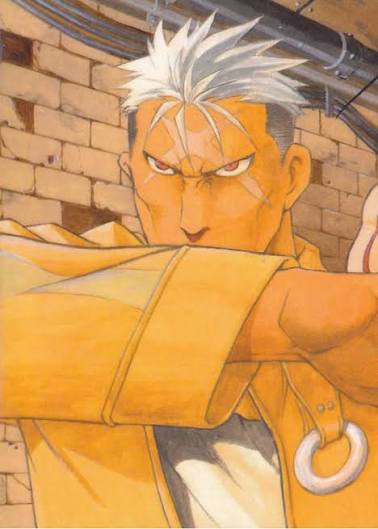
His real name is never revealed, which is fitting for a character who has largely abandoned his former identity. The name “Scar” comes from the prominent scar across his forehead, making the wound itself almost a replacement for the person he once was.
Physically, Scar is imposing. He has a muscular build, dark hair, a large facial scar, and usually wears clothing suited to traveling rather than military combat. His appearance immediately communicates danger, but his personality is more controlled than his reputation suggests.
Scar is serious, disciplined, and intensely focused. He rarely wastes words, and unlike many revenge-driven characters, he does not spend his time loudly announcing his hatred. His anger is usually cold rather than theatrical.
His first major appearance establishes him as a dangerous opponent of State Alchemists. At this stage, Edward and Alphonse see him primarily as a killer who must be stopped. That perspective is understandable, but it is deliberately incomplete.
Scar’s importance becomes clearer as the series reveals what happened to Ishval and how deeply the military’s actions shaped his worldview.
Abilities and Fighting Style
Scar’s fighting style is one of the most distinctive parts of his character.
His right arm carries a tattooed array derived from the research of his older brother. Scar uses it to destroy matter through alchemical deconstruction. Instead of performing the complete alchemical process of understanding, deconstructing, and reconstructing an object, his right arm effectively stops at destruction.
That limitation is exactly what makes it so dangerous.
Against human opponents, Scar does not need a long preparation period or complicated transmutation circle. Once he makes physical contact, his ability can destroy the target’s body at extremely close range.
This gives his fights a brutal physical quality. Scar is not standing at a distance throwing elaborate alchemical attacks. He closes the distance and turns contact itself into a threat.
His combat ability also matters. Scar is a highly capable hand-to-hand fighter with excellent physical strength, speed, and reflexes. His fighting style complements his right arm because he needs to get close enough to use it effectively.
There is an interesting contrast here with Edward Elric.
Edward represents the creative side of alchemy. He uses it to construct weapons, alter terrain, improvise defenses, and manipulate his surroundings. Scar’s original technique represents almost the opposite philosophy: break something down and leave nothing to rebuild.
That makes their clashes more than fights between two powerful characters. Their abilities reflect fundamentally different attitudes toward what alchemy should be used for.
Scar also later gains access to a modified approach to alchemy that changes how he uses his abilities. This development is important because it reflects a larger change in his thinking. His power does not simply become stronger; his understanding of what he can do becomes broader.
Role in the Story
Scar initially functions as one of the most dangerous enemies facing Edward and Alphonse.
His targets are State Alchemists, particularly those connected to the military. This puts him into direct conflict with Edward, who became a State Alchemist despite being young and inexperienced when he entered the military system.
That creates an immediate moral contradiction.
To Scar, Edward is a State Alchemist and therefore connected to the institution responsible for the destruction of Ishval. To Edward, Scar is attacking people based on their occupation and killing individuals who may not all deserve the same judgment.
Neither perspective is completely comfortable.
The series uses Scar to expose the consequences of the Ishvalan war without turning that history into background decoration. His existence is a reminder that the war did not end simply because the military declared victory.
Scar carries the aftermath with him.
His pursuit of revenge also connects him to several major characters. He becomes involved with Edward and Alphonse, Winry Rockbell, the military, and other survivors of the Ishvalan conflict. Each relationship forces a different part of his worldview into the open.
Major spoilers from this point onward.
Scar’s story becomes significantly more complicated when the series reveals the extent of the military’s actions during the Ishvalan conflict. The people he hates are not imaginary representatives of an abstract enemy. Several important characters personally participated in the war.
This does not make Scar’s murders morally correct, but it does make his anger understandable.
That distinction is one of Brotherhood’s strengths.
The series never needs to say that Scar is “right” in order to make viewers understand why he became who he is.
Scar’s Revenge Is Not His Most Interesting Trait
The easiest way to describe Scar is as a revenge-driven character.
The better way is to look at what happens when revenge stops being enough.
Scar’s initial goal is straightforward: kill State Alchemists. If the story ended there, he would be a fairly familiar revenge archetype. Anime has no shortage of characters who lose everything, become consumed by hatred, and hunt the people responsible.
What separates Scar from many of those characters is that Brotherhood allows his ideology to change without pretending his earlier actions never happened.
His transformation is gradual.
The key development is that Scar eventually has to confront a reality that revenge cannot solve. Killing individuals does not restore Ishval. It does not bring his family back. It does not undo the war.
More importantly, his hatred has the potential to turn him into another version of the very system he despises: someone deciding that an entire group of people can be judged according to the actions of others.
That is where Scar becomes much more compelling than a standard revenge character.
Scar and Edward: Two Characters Who Begin on Opposite Sides
Scar’s relationship with Edward is one of the strongest examples of how Brotherhood builds ideological conflict through personal encounters.
Edward initially has every reason to see Scar as an enemy. Scar attacks State Alchemists, and Edward is one of them. Their early encounters are violent because neither has much reason to trust the other.
But the interesting part is what happens afterward.
Edward gradually learns more about Ishval and begins to understand that the military institution he joined has a history that cannot simply be separated from his own identity as a State Alchemist.
Scar, meanwhile, is forced to recognize that Edward is not simply another faceless military officer. Edward is a young alchemist who does not fit neatly into the category Scar originally created in his mind.
Their conflict therefore becomes more uncomfortable over time.
Edward does not become innocent of everything the military represents simply because he personally did not participate in the Ishvalan war. Scar does not become innocent of his killings simply because his anger has a legitimate historical cause.
That moral tension is far more interesting than a simple hero-versus-villain relationship.
Scar and Winry: The Moment His Revenge Stops Being Abstract
Scar’s relationship with Winry is perhaps the most effective demonstration of his moral conflict.
Winry’s parents were killed during the Ishvalan conflict by a State Alchemist, and Scar eventually comes face-to-face with her.
This moment matters because Scar is confronted by someone whose suffering is connected directly to the world he has been fighting against, but who is not simply another enemy.
Winry has every reason to hate Scar.
Scar has every reason, according to his original worldview, to regard the people connected to State Alchemists as part of the enemy.
Instead, the situation forces him to see the person standing in front of him rather than the category he has assigned to her.
That is a major step in his character development.
It also prevents the story from treating forgiveness as something simple. Winry’s pain does not disappear. Scar’s crimes do not disappear. What changes is Scar’s understanding of what his hatred is doing to him.
That is much stronger than having a character suddenly become “good.”
Scar Compared With Other Revenge Characters
Scar fits comfortably into the revenge archetype occupied by characters such as Sasuke Uchiha from Naruto, but the two characters ultimately travel in very different directions.
Sasuke’s revenge becomes increasingly personal and eventually expands into a desire to reshape the political system around him. His story spends enormous time exploring how inherited hatred can manipulate an individual.
Scar’s story is more grounded in collective trauma.
His anger comes from an actual historical massacre and the destruction of his homeland. He is not simply avenging one person. He believes he is acting on behalf of an entire people.
That makes his hatred both more understandable and more dangerous.
The interesting difference is that Scar eventually moves away from defining himself entirely through revenge. His later actions are increasingly motivated by survival, responsibility, and the possibility of rebuilding rather than simply destroying.
In my view, this is where Scar has an advantage over many characters in the same archetype. His development is less about discovering that revenge is “bad” and more about discovering that he has to decide what comes after revenge.
What the Story Could Have Done More With
Scar is one of the characters who arguably deserved even more space.
His premise is enormous. He is an Ishvalan survivor, a religiously motivated fighter, an enemy of the military, a practitioner of a highly unusual form of alchemy, and eventually someone forced to reconsider his entire philosophy.
Brotherhood handles most of this well, but Scar’s internal development sometimes happens alongside a huge number of other storylines.
The result is that some parts of his transformation can feel compressed.
I would not argue that the series needed to make Scar the protagonist. His limited perspective is part of what makes him effective. But more time spent with Ishvalan survivors and Scar’s personal thoughts could have made his ideological transformation even more powerful.
His relationship with his brother is another area with enormous potential. The knowledge Scar receives from him becomes fundamental to the story, yet the emotional history between the brothers could have supported a much deeper exploration of Scar’s beliefs before and after the war.
Still, this is a case where the character works despite the limited space rather than because the story gives him everything he deserves.
Why Fans Love Scar
Scar is compelling because the series refuses to demand a simple answer about him.
You can condemn his murders while understanding his anger. You can recognize the injustice done to Ishval while questioning the way Scar responds to it. You can appreciate his development without pretending that every action he took was justified.
That complexity makes him feel like a person rather than a role.
His visual design helps as well. The enormous scar, powerful build, and intimidating presence immediately communicate the character’s history without requiring exposition every time he appears.
His combat style is equally memorable. Scar fights with directness and purpose. There is very little unnecessary movement, and his destructive alchemy makes even a simple hand-to-hand encounter feel dangerous.
But his greatest strength is his development.
Scar begins by believing that destruction is the only meaningful response left to him. By the end of his journey, he has to confront the possibility that rebuilding requires something entirely different.
That is a much more satisfying arc than simply watching an angry character become heroic.
Frequently Asked Questions
Is Scar a villain in Fullmetal Alchemist: Brotherhood?
Scar begins as an antagonist because he hunts and kills State Alchemists. However, the story gives him a much more complicated role than a conventional villain. His motivations come from the destruction of Ishval and the loss of his family, and his worldview changes considerably as the story progresses.
Why does Scar hate State Alchemists?
Scar’s hatred comes from the Ishvalan Civil War, during which State Alchemists were used by the military against the Ishvalan people. He sees State Alchemists as representatives of the system responsible for destroying his homeland and killing people he cared about.
What is Scar’s real name?
Scar’s real name is never revealed in Fullmetal Alchemist: Brotherhood. “Scar” is the name used to identify him because of the large scar across his forehead.
What does Scar’s right arm do?
Scar’s right arm allows him to perform alchemical deconstruction. Rather than reconstructing matter after breaking it down, the technique is primarily focused on destruction, making physical contact with an opponent extremely dangerous.
Is Scar stronger than Edward Elric?
It is difficult to reduce their abilities to a simple power ranking. Scar’s close-range combat ability and destructive technique give him a major advantage in direct physical encounters, while Edward has greater versatility with alchemy and can adapt his environment to different situations.
Does Scar become a good person?
Scar’s development is better understood as a change in his beliefs rather than a simple transformation from “bad” to “good.” He gradually moves away from revenge as his sole purpose and begins making choices that contribute to a larger goal.
Does Scar forgive the State Alchemists?
Scar does not suddenly forget the crimes committed against Ishval or forgive everyone responsible. His development is more complicated. He learns to work alongside people he once regarded entirely as enemies when circumstances require cooperation.
Why is Scar important to Fullmetal Alchemist: Brotherhood?
Scar gives the story a human perspective on the consequences of the Ishvalan war. Through him, the series explores revenge, collective guilt, racism, responsibility, and the difficulty of rebuilding after violence. His journey also connects several major conflicts within the story.
Conclusion
Scar works because Fullmetal Alchemist: Brotherhood does not try to make his anger disappear.
Instead, it makes him live with it.
His scar, his fighting style, and his hatred are all visible signs of what happened to him, but they are not the whole character. The more important change happens internally: Scar slowly realizes that destroying the people he blames cannot rebuild what was destroyed.
That makes his journey one of the series’ strongest examples of character development.
He is not interesting because he starts as an enemy and eventually helps the heroes. He is interesting because the story forces him to reconsider what justice actually means without erasing the reasons he wanted revenge in the first place.
For a character built around destruction, Scar’s most meaningful achievement is ultimately learning how to choose something that can be rebuilt.