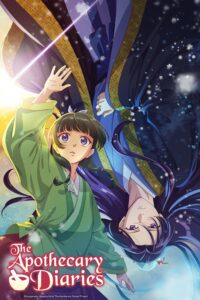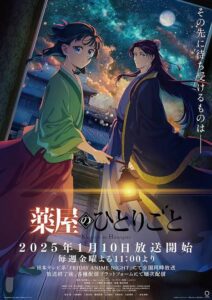
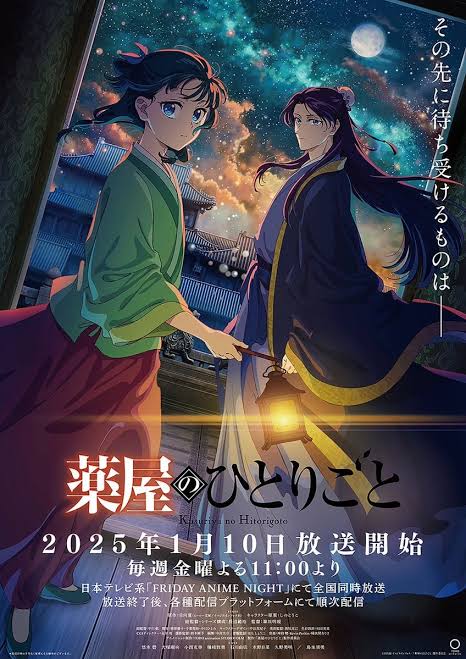
The Apothecary Diaries Season 2
Introduction
Season 1 of The Apothecary Diaries introduced Maomao as the palace servant who could look at a strange illness, suspicious food or unexplained death and immediately become more interested than frightened.
Season 2 understands that the novelty is gone.
Maomao is no longer an accidental observer who happens to solve palace problems. People now know what she can do, Jinshi relies on her more often, and the consequences of getting involved in palace affairs are considerably larger.
That change is what makes Season 2 interesting.
The series doesn’t simply give Maomao bigger mysteries. It starts placing her inside situations where solving the mystery is only half the problem. Knowing the answer can be dangerous. Acting on that knowledge can be even worse.
Season 2 is therefore less about introducing Maomao’s unusual world and more about showing what happens after she has become useful to it.
And yes, I think it is worth watching — although viewers expecting Season 1 with bigger mysteries may be surprised by how much more political and character-focused the second season becomes.
Overview
The Apothecary Diaries Season 2 continues Maomao and Jinshi’s lives inside the imperial court, where medical problems, personal rivalries and political maneuvering increasingly overlap.
The season began airing in Japan on January 10, 2025, and was planned as a continuous two-cour broadcast. Crunchyroll streamed the season internationally as part of its Winter 2025 lineup.
The important difference from Season 1 is the scale of the problems.
Season 1 often allowed Maomao to approach a mystery from the outside. Someone gets sick, something seems suspicious and she works backward until the explanation becomes clear.
Season 2 increasingly puts her closer to the center of the machinery creating those problems.
That makes the mysteries feel less like isolated puzzles.
A poisoning isn’t merely about identifying the poison. A person’s position in the palace determines whether the truth can safely be revealed. A pregnancy isn’t simply a medical development. It can affect the balance between powerful people. A seemingly innocent assignment can become connected to much larger political interests.
Season 2’s greatest strength is that it realizes the palace itself is the mystery.
Story Summary: What Happens in Season 2?
Without getting into major spoilers, Season 2 begins with Maomao continuing her work around the Rear Palace while becoming increasingly valuable to Gyokuyou and Jinshi.
One of the early storylines involves Gyokuyou’s pregnancy and the precautions surrounding it. Maomao’s knowledge becomes particularly useful because the dangers surrounding a pregnant consort aren’t limited to ordinary medical problems.
From there, the season expands outward.
Maomao encounters new people, unfamiliar political circumstances and problems that cannot always be solved simply by identifying a physical cause. Some mysteries remain intimate and medical, while others involve court politics and the intentions of people operating several steps ahead.
The second half becomes especially important because the story starts moving Maomao and Jinshi outside the comfortable boundaries established earlier.
The northern hunting trip is a major example. What begins as a political and social occasion eventually becomes a much more dangerous situation, forcing Jinshi and Maomao to deal with threats that have nothing to do with the relatively controlled environment of the palace.
This is where Season 2 feels different.
The first season teaches you how Maomao thinks.
The second season starts asking whether that way of thinking is enough to keep her safe.
The pacing remains deliberate, but the individual mysteries increasingly connect to larger story threads. Characters who might initially appear to be supporting players can become much more significant once their motives are understood.
For that reason, Season 2 works best when watched as a complete season rather than as a collection of weekly mysteries.
Main Characters
Maomao
Maomao remains the reason the series works.
But Season 2 gives her a problem that cannot be solved with medical knowledge alone: people are becoming interested in her.
That is dangerous for someone whose preferred method of survival has always been to remain unnoticed.
Her reactions to medicine and poison are still wonderfully strange. Put something potentially toxic in front of her and she can become more curious than alarmed.
What changes is her awareness of the consequences.
In Season 1, Maomao could sometimes investigate because nobody expected much from a low-ranking servant. In Season 2, her reputation precedes her. Her abilities have become an asset, which means powerful people have more reasons to involve her in their affairs.
That creates an entertaining contradiction.
Maomao wants fewer problems.
Her competence keeps producing more of them.
Jinshi
Jinshi’s role becomes considerably more complicated.
Season 1 could make him look like the beautiful palace official whose primary purpose was to create comedy and romantic tension around Maomao.
Season 2 spends more time reminding you that he is a political figure.
His relationship with Maomao remains one of the season’s best sources of humor, particularly because Jinshi can be very obvious about what he wants while Maomao remains spectacularly uninterested in interpreting him romantically.
But there is a more serious side to him now.
The more political responsibility Jinshi carries, the less freedom he has to simply behave as the charming official Maomao knows.
That makes his interactions with her more interesting because their personal relationship increasingly exists alongside political obligations.
Gyokuyou
Gyokuyou becomes even more important because her pregnancy changes the stakes around her.
She is not simply a character Maomao protects.
She understands the political environment she occupies and knows that pregnancy inside the imperial court carries consequences beyond childbirth itself.
Her trust in Maomao therefore becomes more meaningful. She needs someone capable of noticing things other people miss, but she also has to understand what happens if that person discovers something inconvenient.
Xiaolan
Xiaolan provides something Maomao doesn’t naturally have: an ordinary friendship.
Their relationship is valuable because Maomao’s world can become extremely complicated. Xiaolan brings the story back toward everyday life and gives Maomao someone she can interact with without constantly thinking about political consequences.
That contrast makes their scenes more important than they initially appear.
Suirei
Suirei is one of Season 2’s more interesting additions because she doesn’t immediately fit into a simple ally-or-enemy category.
Her presence contributes to the season’s larger theme: inside the palace, knowing someone’s role doesn’t necessarily tell you their motive.
She becomes particularly interesting as the story moves toward its more serious conflicts.
Basen
Basen is another character who becomes more useful as the story expands beyond the Rear Palace.
His role helps show that Jinshi’s world has an entire network of people operating around him. Maomao’s investigations are no longer happening in isolation.
That becomes increasingly important once the story moves into situations where security and political loyalty matter as much as medicine.
Why You Should Watch Season 2
The best reason to continue with Season 2 is the way it changes the meaning of Maomao’s intelligence.
A good example is the season’s treatment of medical knowledge.
Maomao can often identify what is happening faster than everyone around her. But Season 2 increasingly asks a more interesting question:
What should she do after discovering the truth?
That distinction matters.
If the wrong person learns something, people can be harmed. If Maomao exposes a secret without understanding the political situation, she could put herself or someone else in danger.
The northern hunting storyline is especially effective because it removes some of the safety provided by the palace environment.
Then there is Maomao and Jinshi.
Their relationship continues to progress, but the anime wisely refuses to turn the series into a straightforward romance. Jinshi can make his feelings obvious to the audience while Maomao remains distracted by completely different concerns.
That would become repetitive in a weaker show.
Here, it works because their relationship is tied to the larger question of what each character actually understands about the other.
Animation & Art Style
Season 2’s visual strengths are mostly in character acting and atmosphere rather than spectacle.
That is appropriate for the material.
The palace continues to look carefully designed, with clothing, architecture, gardens and interiors helping communicate the difference between people who possess power and those who merely work around it.
Maomao’s facial expressions remain one of the production’s secret weapons.
Her reactions can completely change the tone of a scene. A conversation that should be romantic can become comedy simply because Maomao looks more interested in something else happening nearby.
The season also benefits from stronger visual variety once the story moves beyond the familiar palace environment.
The production is handled by TOHO animation STUDIO and OLM. The official Season 2 staff credits Norihiko Naganuma as chief director and series composer, with Akinori Fudesaka directing and Wataru Nakagawa serving as assistant director.
One thing the season does not attempt is turning every important moment into an animation showcase.
There are no constant action sequences.
If your definition of great animation requires fight choreography every few episodes, this isn’t going to satisfy you.
But for a mystery drama, the production understands where its visual effort matters.
Music & Voice Acting
The voice acting remains one of the anime’s biggest advantages.
Aoi Yuuki’s Maomao is particularly difficult to replace because the performance needs to balance several contradictory traits: intelligence, curiosity, emotional distance, deadpan humor and occasional vulnerability.
She can make Maomao sound genuinely fascinated by a poison one second and completely unimpressed by Jinshi’s flirting the next.
Takeo Otsuka’s Jinshi works for the opposite reason.
His voice sells the polished, attractive persona that everyone around him sees, while also allowing the character’s frustration and uncertainty to come through when Maomao refuses to respond as expected.
The official Season 2 credits list Satoru Kousaki, Kevin Penkin and Alisa Okehazama as composers. The opening theme is “Hyakkaryoran” by Lilas Ikuta, while the ending theme is “Shiawase no Recipe” by HIRAIDAI.
The opening is especially well suited to the season because its presentation reflects the increasingly complicated relationship between Maomao, Jinshi and the world around them.
Where to Watch The Apothecary Diaries Season 2
If you’re looking for the legal streaming option, Crunchyroll is the main answer.
Crunchyroll confirmed Season 2 as part of its Winter 2025 lineup and streamed the series from January 10, 2025. The original simulcast territories included North America, Central America, South America, Europe, Africa, Oceania, the Middle East and CIS.
The original subtitle release was scheduled for Fridays at 9:15 a.m. Pacific Time, with dubbed releases following the platform’s schedule.
For viewers in India, Crunchyroll is the service to check first rather than assuming Netflix availability.
The important distinction is that availability of specific dubs can vary by territory. Crunchyroll’s listing should therefore be treated as the current source for your account’s available audio tracks rather than assuming every language is offered in every country.
If you are watching Season 2 now, you don’t need to wait for a weekly release. The season has completed its broadcast, so the full season is available to catch up on where licensed in your territory.
Season 2 vs Season 1: Which Is Better?
This is where I think the online conversation sometimes gets the comparison wrong.
Season 1 is the better introduction to The Apothecary Diaries.
Season 2 is the better demonstration of what the series can become.
Season 1 has the advantage of discovery. You are learning about Maomao, the Rear Palace, Jinshi and the show’s unusual approach to mystery.
Season 2 doesn’t have that luxury.
Instead, it can assume that you already understand the characters and spend more time pushing them into situations where their established personalities have consequences.
That makes Season 2 less immediately accessible but more rewarding if you’re already invested.
If you loved Season 1 primarily because you wanted more little poison and medical mysteries, Season 2 may feel less consistent.
If you loved Season 1 because you wanted to understand Maomao, Jinshi and the political world around them, Season 2 is arguably the stronger season.
My choice: Season 2 is better overall, but Season 1 is more immediately entertaining.
Season 2 vs Similar Anime
The Apothecary Diaries vs Raven of the Inner Palace
Raven of the Inner Palace is probably the closest comparison if you’re specifically looking for another palace mystery anime.
The major difference is supernatural storytelling.
Raven of the Inner Palace uses its setting to tell a darker supernatural story, while The Apothecary Diaries generally approaches strange events through medicine, observation and human behavior.
I prefer The Apothecary Diaries because Maomao’s reasoning gives the audience something to actively follow.
Choose Raven of the Inner Palace if atmosphere and supernatural mystery matter more to you.
Choose The Apothecary Diaries if you want to solve problems alongside the protagonist.
The Apothecary Diaries vs Frieren
This comparison may seem strange, but the two shows share an important quality: they trust slow storytelling.
Frieren uses its slower pace to explore memory, relationships and the passage of time.
The Apothecary Diaries uses it to establish social systems, character motives and mysteries.
If you want fantasy adventure, Frieren is the obvious choice.
If you want character-driven mystery inside a political setting, I would choose The Apothecary Diaries.
Neither is better in every category.
They simply reward different kinds of attention.
Manga vs Anime: Should You Read the Manga After Season 2?
Yes, but there is an important distinction.
The anime is an excellent way to experience Maomao because voice acting and facial expressions add a lot to her personality.
The original light novels provide considerably more access to Maomao’s thoughts and reasoning.
That matters because Maomao is a character whose internal reactions are often more interesting than what she says aloud.
The manga is also worth reading if you prefer visual storytelling, but readers should remember that The Apothecary Diaries has more than one manga adaptation.
If your goal is to get deeper into the original narrative rather than simply replaying the anime, the light novels are the strongest choice.
If you’ve finished Season 2 and don’t want to wait for more anime, however, the light novel is where I would continue.
Strengths
- Maomao remains one of the most distinctive protagonists in modern anime.
- Season 2 gives Jinshi substantially more political weight.
- Medical mysteries increasingly connect with larger political problems.
- The palace setting feels like a functioning social system rather than scenery.
- The relationship between Maomao and Jinshi progresses without overwhelming the mystery.
- The season rewards viewers who remember earlier details.
- The northern storyline successfully expands the world beyond the Rear Palace.
- The voice acting continues to be excellent.
Weaknesses
Season 2’s biggest weakness is that its increased ambition occasionally hurts its momentum.
Season 1 could make an individual mystery satisfying within a single episode or small arc.
Season 2 increasingly asks you to remember characters, political relationships and details that may not pay off immediately.
That’s rewarding when everything connects.
It is less rewarding when you simply want a clean mystery with a beginning, middle and end.
The second issue is Maomao herself.
Her detached attitude is one of the reasons the character is so entertaining, but the Jinshi relationship sometimes reaches a point where the joke becomes predictable: Jinshi clearly understands something, the audience understands it, and Maomao remains focused on something completely unrelated.
I still enjoy it.
I just don’t think every romantic beat lands as strongly as the show’s reputation might suggest.
Season 2 is at its best when romance is one part of the character conflict rather than the entire joke.
Who Should Watch Season 2?
Watch Season 2 if Season 1 worked for you because of Maomao’s investigations, palace politics or the slow development of the characters.
It is particularly rewarding if you enjoyed noticing details in Season 1 and wondering whether they would matter later.
You should also continue if Jinshi’s character interested you but you wanted more than his flirtation with Maomao.
Season 2 gives him considerably more responsibility and makes his position within the imperial hierarchy more relevant.
And if you liked the medical mysteries but want the story to become larger, this is exactly the direction the series takes.
Who Should Skip Season 2?
If you only watched Season 1 for self-contained medical mysteries, don’t expect Season 2 to repeat that formula unchanged.
The story becomes more politically complicated.
There are also stretches where the anime expects you to remember people and events from earlier episodes rather than explaining everything again.
That is good serialized storytelling, but it can be frustrating if you’re watching casually in short bursts.
And if you wanted the romance between Maomao and Jinshi to become a straightforward relationship, this season will probably test your patience.
Final Verdict
The Apothecary Diaries Season 2 is not simply Season 1 with better mysteries.
It is the point where the series starts showing what happens when Maomao’s ability to notice things becomes politically valuable.
That is the season’s biggest success.
Maomao can identify poison. She can understand symptoms. She can reconstruct what probably happened.
But Season 2 repeatedly demonstrates that knowing the truth doesn’t automatically mean you’re free to act on it.
That idea gives the palace mysteries more weight than they initially appear to have.
The season also improves Jinshi by giving him more to do than flirt with Maomao, while the supporting cast becomes increasingly relevant to the larger story.
I wouldn’t say every episode is equally compelling. Some of the slower material will test viewers who prefer tightly contained mysteries.
But taken as a complete season, the payoff is strong.
If Season 1 convinced you that The Apothecary Diaries was an unusually clever mystery anime, Season 2 makes the argument that it is something larger: a political character drama where medicine happens to be one of its sharpest storytelling tools.
Is The Apothecary Diaries Season 2 worth watching? Yes.
My rating: 9/10
If you liked Season 1, I would absolutely continue.