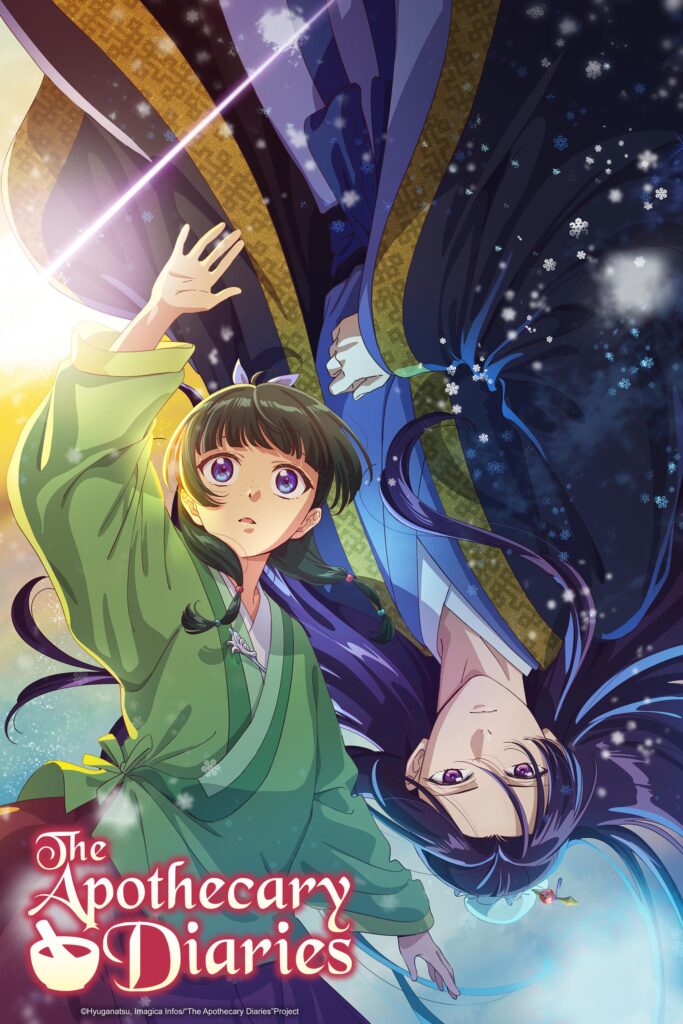
The Apothecary Diaries
Introduction
The first thing that makes The Apothecary Diaries work is also the thing that makes it difficult to describe with a normal anime recommendation: Maomao is not interested in being the heroine.
She would much rather examine poison, identify a medicinal plant, or investigate a suspicious illness than participate in palace romance. When she is pulled into the Imperial Palace’s problems, her reactions are often hilariously inappropriate for the situation. A beautiful court official tries to charm her; Maomao is more interested in figuring out whether something he touched was poisonous.
That attitude gives The Apothecary Diaries its personality. The series has palace intrigue, murder mysteries, romance, social hierarchy and medical investigation, but it rarely treats any of those as separate pieces. A seemingly harmless illness can expose a political problem. A small change in someone’s behavior can reveal a much larger secret.
After two 24-episode seasons, the anime has established itself as one of the stronger mystery-driven anime of the 2020s. The real question is whether it deserves the enormous amount of praise surrounding it.
My answer: yes, but not for the reason you might expect.
Overview
The Apothecary Diaries follows Maomao, a young apothecary who is kidnapped and sold into service at the Imperial Palace. Rather than trying to escape immediately, she keeps her head down and intends to complete her period of service quietly.
That plan lasts about as long as you’d expect.
When Maomao notices that the emperor’s children are becoming dangerously ill, she uses her knowledge of medicine and poison to investigate the problem. Her solution attracts the attention of Jinshi, a high-ranking palace official, and Maomao gradually becomes involved in increasingly complicated cases.
The interesting part isn’t simply that Maomao solves mysteries. It is how little the palace resembles a conventional detective story.
She doesn’t have a badge, authority or laboratory. She works within a rigid social hierarchy where servants cannot casually question nobles and where revealing the wrong information can be dangerous. Her medical knowledge becomes valuable precisely because most people around her don’t possess it.
The anime is produced by TOHO animation STUDIO and OLM, with music by Satoru Kousaki, Kevin Penkin and Alisa Okehazama.
Story Summary: What Is The Apothecary Diaries About?
The story begins as a collection of seemingly unrelated palace incidents.
Someone becomes sick. Someone dies. A strange rumor spreads. A suspicious medicine appears. A consort has a problem that nobody can explain.
Maomao investigates these situations almost clinically. She observes what other people overlook, tests possibilities and uses her knowledge of medicine, poison and human behavior to connect details.
But the series gradually reveals that the palace itself is the larger mystery.
The people living inside it are trapped in a complicated system of rank, family, beauty, childbirth, wealth and political influence. A person’s position can determine what they are allowed to know, who they can speak to and even how much protection they receive when something goes wrong.
This is why the anime’s pacing is different from a traditional thriller. Some episodes feel like individual mysteries while others quietly plant information that becomes important much later.
Season 1 spends considerable time establishing the Rear Palace and Maomao’s relationships with people such as Gyokuyou, Jinshi and the other consorts. By the time the story reaches the Lakan-related material around Episodes 18–24, earlier character details suddenly carry much more weight.
Season 2 pushes the political side further. The mysteries become less isolated, and Maomao’s position makes it increasingly difficult for her to remain an anonymous observer.
That gradual escalation is one of the show’s smartest decisions.
Main Characters
Maomao
Maomao is easily the biggest reason to watch the series.
Her defining characteristic isn’t simply intelligence. It’s what she chooses to be intelligent about.
She has an almost alarming fascination with poison. Someone else might react to a suspicious symptom with fear; Maomao can become visibly interested because she wants to know what caused it.
That makes her deductions entertaining without turning her into an all-knowing detective. She can misread situations, particularly when romance or social behavior is involved.
Her reaction to Jinshi is particularly funny because she repeatedly refuses to interpret his behavior in the way almost everyone else does.
More importantly, Maomao’s background gives her practical knowledge that people from the palace don’t possess. She understands medicine because she grew up around it, not because the story suddenly decided to give its protagonist a convenient superpower.
Jinshi
Jinshi initially looks like the classic beautiful palace man who exists to create romantic tension.
That description becomes increasingly inadequate.
His position gives him access to information and influence, while his relationship with Maomao creates one of the show’s most unusual character dynamics. Jinshi often expects a particular reaction from her and gets something completely different.
What makes him more interesting is the gap between his public image and what he actually knows about palace politics.
The anime gradually moves him away from being merely the charming counterpart to Maomao and toward someone who has to make decisions within the same political machine that Maomao is investigating.
Gyokuyou
Gyokuyou could easily have been written as a stereotypical kind-hearted royal consort.
Instead, the series gives her something more valuable: political awareness.
She understands her position and knows how to protect herself and the people around her. Her relationship with Maomao works because neither character treats the other as completely helpless.
Gyokuyou’s presence also helps show why the palace isn’t simply divided into “good people” and “bad people.” Survival often requires calculation even from characters the audience likes.
Lihua
Lihua’s storyline is one of the early examples of how The Apothecary Diaries handles tragedy without turning every situation into melodrama.
Her experiences after losing her child demonstrate how palace hierarchy affects personal suffering. The anime doesn’t need a villain standing in the background explaining everything. The system itself creates pressure.
That makes her story more uncomfortable than a straightforward revenge plot would have been.
Gaoshun
Gaoshun is one of the quieter characters in the series, but his role is important because he provides a grounded contrast to Jinshi.
He understands Jinshi’s behavior better than Maomao does and often has to manage the consequences.
His presence also makes the palace feel like an actual workplace rather than a stage built exclusively for Maomao and Jinshi.
Luomen
Luomen’s influence on Maomao is easy to underestimate.
He represents the intellectual and medical foundation behind Maomao’s abilities. The series doesn’t treat her knowledge as something that appeared magically; her experience has a history.
That relationship becomes especially meaningful when the story starts exploring Maomao’s past more seriously.
Why You Should Watch The Apothecary Diaries
Watch it for the payoff between small details and later revelations.
Episode 6’s garden party is a good early example. What initially looks like an elegant social gathering becomes another opportunity for Maomao to observe how information, appearance and danger overlap inside the palace.
Later, the Lakan storyline shows what happens when the anime takes the character relationships it established earlier and gives them emotional consequences.
The series also understands that Maomao doesn’t need to dramatically announce every deduction. Sometimes the funniest part is watching her arrive at an answer while everyone else remains completely confused.
The result is a show where paying attention actually improves the experience.
That sounds obvious, but many mystery anime explain their clues so aggressively that the audience rarely gets to participate. The Apothecary Diaries gives you enough information to occasionally suspect something before Maomao explains it.
When you are right, it feels rewarding.
When you’re wrong, Maomao usually makes you understand why.
Animation & Art Style
The strongest visual decision in The Apothecary Diaries isn’t flashy animation. It is environmental detail.
The Rear Palace feels expensive but restrictive. Gold, silk, ornate architecture and carefully designed clothing create a world where beauty and danger occupy the same space.
The production also uses Maomao’s expressions extremely well. Her deadpan reactions are not simply comedy inserts; they communicate how differently she processes the world around her.
This becomes particularly effective during scenes involving Jinshi. His character is designed to look almost absurdly attractive to other characters, while Maomao frequently reacts as though somebody has shown her an interesting laboratory specimen.
The series is not an action anime, so don’t expect constant sakuga showcases. Its visual strengths are composition, character acting, color and atmosphere rather than spectacular combat.
That is exactly the right choice for this story.
Music & Voice Acting
The music is credited to Satoru Kousaki, Kevin Penkin and Alisa Okehazama.
The combination works particularly well because the show moves between three moods: palace elegance, mystery and comedy.
Aoi Yuuki’s performance as Maomao is the standout.
She can make Maomao sound genuinely fascinated by something disturbing without turning the character into a caricature. Her delivery also makes Maomao’s dry reactions much funnier than the dialogue alone would suggest.
Takeo Otsuka’s Jinshi provides the necessary contrast. His performance sells both Jinshi’s polished public persona and the moments where that composure starts to crack.
The Japanese cast is excellent, but you don’t have to watch exclusively in Japanese. Crunchyroll currently lists both Japanese and English audio, alongside Hindi, Tamil and Telugu audio options, among others.
Where To Watch The Apothecary Diaries: Global Streaming Guide
This is one area where checking your region matters.
Crunchyroll is the safest primary recommendation. Its current listing carries both seasons and provides sub and dub options. The platform lists Japanese, English, Hindi, Tamil and Telugu audio among its available options, although exact availability can vary by territory.
For India specifically, Crunchyroll is the practical choice if you want the anime with officially available Hindi, Tamil or Telugu audio.
Netflix is more complicated because licensing differs between countries. Netflix’s catalog pages list The Apothecary Diaries in some regional anime catalogs, while the Indian title page currently reports that the title isn’t available in the country.
The original Season 1 began broadcasting in Japan in October 2023, with the first three episodes airing together on the initial Japanese broadcast.
Season 2 began on January 10, 2025, with weekly Friday releases. Crunchyroll simulcast the season across a large range of territories including North and South America, Europe, Africa, Oceania, the Middle East and CIS.
As of August 2026, two 24-episode seasons are available. Season 3 is scheduled to begin in October 2026, with its second cour planned for April 2027.
The Apothecary Diaries vs The Raven of the Inner Palace
If you’re choosing between The Apothecary Diaries and The Raven of the Inner Palace, I would pick The Apothecary Diaries for most viewers.
Both use an imperial-court setting and mysterious problems surrounding powerful people, but their priorities are different.
The Raven of the Inner Palace leans harder into supernatural mystery and atmosphere. Its world feels more mythical and its central mystery has a stronger fantasy identity.
The Apothecary Diaries is more grounded in observation, medicine, social behavior and political consequences.
The difference becomes obvious when Maomao investigates an apparently supernatural problem. Her first instinct isn’t to accept the supernatural explanation. She starts looking for a physical cause.
So:
- Choose The Apothecary Diaries if you want deduction, medicine, palace politics and dark comedy.
- Choose The Raven of the Inner Palace if supernatural court mysteries and a more melancholic atmosphere appeal to you.
For mystery fans specifically, I think The Apothecary Diaries has the stronger long-term character development.
Manga vs Anime: Which Version Is Better?
The anime is a very good adaptation, but it doesn’t contain everything that makes the original story interesting.
The biggest difference is Maomao’s internal reasoning.
In the light novel, you spend much more time inside Maomao’s head. You see her consider possibilities, reject explanations and work through medical details. The anime has to compress that process into dialogue, visual reactions and shorter explanations.
This changes the experience.
In the anime, Maomao can sometimes appear to simply know the answer. In the novel, you are more likely to see how she arrived there.
There are also two manga adaptations, which makes online reading guides unnecessarily confusing. The Nekokurage manga is the version most closely associated with the anime and is the major English-language manga adaptation; another adaptation by Minoji Kurata follows the source differently.
My recommendation is simple:
Watch the anime first. Read the light novel afterward if you become interested in Maomao’s reasoning and the deeper political material.
If you only want to continue the story after Season 2, the light novel continuation is around Volume 5; if you want the fullest version, start from Volume 1.
Strengths
- Maomao is an unusually strong protagonist because her intelligence is connected to her background rather than a generic “genius” label.
- Mysteries often reward viewers who pay attention.
- Palace politics gradually become more important without overwhelming the early story.
- Maomao and Jinshi have a relationship that works because they misunderstand each other in genuinely funny ways.
- Side characters receive enough development to make later revelations matter.
- The setting has a distinctive visual identity.
- The anime trusts quiet scenes instead of forcing every important moment into melodrama.
- The medical mysteries give the series a structure that separates it from conventional palace romance.
Weaknesses
The biggest weakness is that the episodic mystery structure can make the first half feel less connected than the story actually is.
Some viewers will watch an early episode, enjoy Maomao solving a problem and assume the series is simply going to repeat that formula for 24 episodes.
It isn’t.
But the show doesn’t always make its larger direction obvious immediately.
There is also a deliberate imbalance between Maomao’s intelligence and her emotional awareness. That is funny most of the time, but occasionally the romantic material can feel like it is waiting for Maomao to catch up with information the audience understood several episodes earlier.
The second issue is subjective but important: if you primarily want a fast mystery thriller, The Apothecary Diaries may be too patient. It spends substantial time on relationships, palace routines and social politics.
That’s not wasted material.
It just isn’t fast.
Who Should Watch This Anime?
You should watch The Apothecary Diaries if you enjoy:
- Mystery stories where clues matter.
- Intelligent female protagonists.
- Historical or pseudo-historical settings.
- Medical mysteries.
- Political intrigue without constant battles.
- Slow-burn character relationships.
- Dark situations mixed with dry comedy.
- Stories where seemingly minor details become important later.
You don’t need to know anything about Chinese history to understand it. The setting is fictional, although it draws heavily from historical Chinese court culture.
Who Should Skip This Anime?
Skip it if you’re looking for a battle-heavy anime or a romance where the couple becomes the central focus immediately.
It is also probably not for you if you need every episode to end with a major cliffhanger.
The show is built around observation. Some episodes deliberately spend time establishing a person, object, rumor or social situation before revealing why it matters.
If that sounds boring rather than intriguing, the anime’s strengths may work against you.
Final Verdict
The Apothecary Diaries deserves its reputation, but I wouldn’t sell it simply as “a smart anime with a great female protagonist.”
Its real strength is the way medicine, mystery and palace politics constantly interfere with one another.
Maomao doesn’t enter the palace intending to become a detective. She simply can’t ignore something medically interesting. That small character trait gradually drags her into problems far bigger than she initially understands.
The best episodes are the ones where you realize that the mystery wasn’t really about the obvious problem at all. The illness, rumor or suspicious object is only the surface. Underneath it is usually something about status, family, jealousy, money or survival.
That makes the show more rewarding as it progresses.
The anime is also a rare case where I recommend watching before reading. The performances, expressions and atmosphere add something substantial to Maomao’s character, even though the light novel ultimately gives you a deeper understanding of her thoughts.
Is The Apothecary Diaries worth watching? Absolutely.
If you enjoy mystery and character-driven stories more than action, it is one of the easiest anime recommendations I can make.
Verdict: 9/10