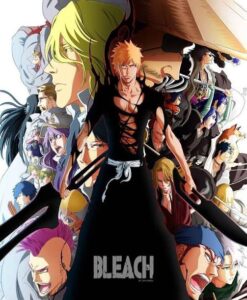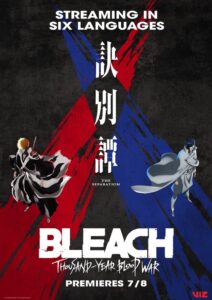
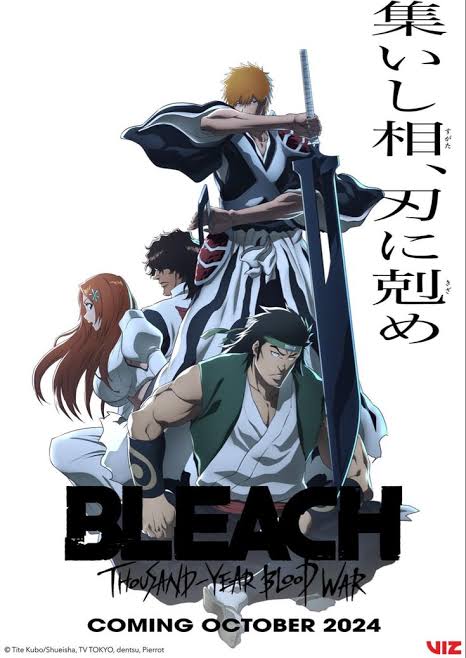
Bleach: Thousand-Year Blood War Part 3 – The Conflict
Introduction
Bleach: Thousand-Year Blood War Part 3 – The Conflict is where the final war stops feeling like a collection of separate battles and starts looking like the collapse of the entire Bleach universe.
Part 2 ended with Yhwach and the Royal Guard reaching the Soul King’s Palace. Part 3 picks up from there and immediately raises the scale.
The Soul Reapers are no longer defending the Seireitei.
They are fighting for the structure of the worlds themselves.
But the most interesting conflict isn’t actually Ichigo versus Yhwach.
It is Ichigo versus Uryu.
For years, Uryu has been one of Ichigo’s closest friends and most reliable allies. Now he is standing on the opposite side of the war, carrying a Quincy heritage that the series has spent decades slowly revealing.
Part 3 turns that relationship into the emotional backbone of the cour.
At the same time, Squad Zero finally gets the extended showcase fans had been waiting for, the Schutzstaffel become genuine monsters rather than another group of powerful enemies, and the anime begins adding material that wasn’t present in the manga.
That last point matters.
Unlike the earlier cours, The Conflict sometimes feels like the anime is actively trying to repair the rushed parts of the original final arc.
Overview
Bleach: Thousand-Year Blood War Part 3 – The Conflict continues immediately after Yhwach reaches the Royal Palace.
The official story material establishes that the Soul Reapers are now attempting to respond to the Wandenreich’s advance while Ichigo and his allies are drawn into the battle surrounding the Soul King’s Palace.
The cour covers Episodes 27 through 40 and consists of 14 episodes.
But the numbers aren’t particularly important.
What matters is what the season does with the characters.
The first two cours were largely about revealing the Quincy war and rebuilding Ichigo after his defeat.
Part 3 is about consequences.
Yhwach’s invasion has progressed too far for the Soul Society to simply restore what was lost.
The Soul King’s existence becomes directly connected to the fate of the worlds.
Uryu’s position inside Yhwach’s army becomes increasingly difficult to interpret.
And the Soul Reapers discover that even their strongest fighters may not understand the true scale of the enemy they are facing.
That gives The Conflict a much more desperate atmosphere.
The heroes aren’t preparing for the final battle anymore.
They are already inside it.
Story Summary: What Is Part 3 About?
Part 3 begins with the war moving into the Royal Palace.
Yhwach’s forces have reached the domain of the Soul King, and the Royal Guard—Squad Zero—stands between the Quincy emperor and his objective.
This immediately creates a different kind of battle from the earlier cour.
The Soul Reapers who fought the Sternritter in the Seireitei were defending their home.
Squad Zero is defending something much larger.
Their duty is tied to the Soul King and the balance that keeps the different realms functioning.
Meanwhile, Ichigo and his companions are drawn deeper into the conflict.
Uryu is now fighting alongside Yhwach, but his true intentions remain uncertain.
That uncertainty becomes increasingly important as Haschwalth begins questioning whether Uryu has genuinely accepted the Wandenreich.
The cour also gives several returning characters major opportunities.
Shunsui Kyoraku takes a more active leadership role.
Mayuri Kurotsuchi becomes central to several unusual battlefield developments.
Orihime and Chad remain involved despite the increasingly absurd scale of the conflict.
Yoruichi finally returns to the battlefield.
And the remaining Sternritter begin fighting opponents who can actually challenge their abilities.
The story moves between several battlefields, but the central question remains the same:
Can the Soul Reapers prevent Yhwach from fundamentally changing reality?
The answer is not resolved in this cour.
Instead, Part 3 pushes the conflict closer to the final confrontation while ending on the personal question surrounding Uryu.
Main Characters
Ichigo Kurosaki
Ichigo’s biggest challenge in Part 3 isn’t learning another new transformation.
It is figuring out where he belongs.
By this stage, Ichigo’s Soul Reaper, Hollow and Quincy identities have become inseparable.
That becomes particularly important because Yhwach’s connection to Quincy power gives the villain a relationship with Ichigo that goes beyond ordinary hero-versus-villain storytelling.
Ichigo also has to confront the fact that Uryu has apparently chosen the enemy.
His reaction isn’t simple anger.
He still treats Uryu as his friend.
That makes their eventual confrontation much more uncomfortable than a conventional rivalry.
Uryu Ishida
Uryu is the character who gives The Conflict its title meaning.
His allegiance to Yhwach has been established since Part 2, but Part 3 finally begins answering the obvious question:
Why?
The season doesn’t immediately give the audience a simple explanation.
Instead, Uryu has to survive suspicion from the people he is supposedly fighting alongside while also keeping his distance from Ichigo.
The official Episode 40 synopsis brings that conflict to its peak: Haschwalth confronts Uryu, Ichigo arrives, and Uryu is forced to point his bow at his old friend.
That is the kind of character conflict the final arc needed more of.
The war may involve gods, immortal beings and reality manipulation.
But Uryu pointing an arrow at Ichigo still feels personal.
Yhwach
Yhwach becomes much more terrifying in Part 3 because his goal is no longer abstract.
He isn’t simply trying to defeat the Soul Reapers.
He is moving toward the Soul King and the fundamental structure of the worlds.
That makes the final conflict existential rather than political.
His presence also changes how every other character behaves.
Even the strongest Quincy aren’t simply fighting because they hate Soul Reapers.
They are fighting because Yhwach has given them a vision of what the world should become.
The frightening part is that he has the power to make that vision real.
Shunsui Kyoraku
Shunsui has always been one of the most relaxed captains in the series.
Part 3 shows what happens when that personality has to disappear.
As Captain-Commander, Shunsui isn’t simply another fighter.
He has to make decisions that affect the entire Soul Society.
That makes his scenes more interesting than another Bankai reveal.
He has to think like a leader while knowing that there may not be a good option available.
Mayuri Kurotsuchi
Mayuri remains completely ridiculous.
That is precisely why he works.
In a story increasingly filled with characters capable of destroying dimensions, Mayuri’s greatest weapon is still being the strangest person in the room.
His battle tactics rely less on raw power and more on preparation, experimentation and exploiting whatever bizarre weakness an opponent happens to possess.
Part 3 uses him particularly well because his methods fit the increasingly unconventional nature of the war.
Squad Zero
Squad Zero finally gets the treatment its reputation demanded.
The Royal Guard was introduced as a group so powerful that the entire Gotei 13 combined couldn’t simply replace them.
Part 3 finally gives viewers a reason to understand why.
The anime expands their battles and personalities, making them feel less like a lore footnote and more like genuine pillars of Soul Society’s history.
That improvement is one of the biggest reasons manga readers should not simply assume they already know exactly how these scenes will play out.
Why You Should Watch
If you have already watched Parts 1 and 2, there is almost no reason to stop before Part 3.
This is the cour where several long-running pieces finally collide.
Ichigo’s heritage matters.
Uryu’s Quincy identity matters.
The Soul King’s existence matters.
Squad Zero matters.
The Royal Palace matters.
And the relationship between Ichigo and Uryu becomes part of the main conflict instead of remaining a side story.
Episode 27, “A,” immediately continues the Royal Palace confrontation.
The season then moves through battles involving Squad Zero, the Schutzstaffel and the remaining Soul Reapers before eventually returning to the Uryu storyline.
The later episodes are particularly strong because the anime understands that the audience needs breathing room between major reveals.
The fights are still the main attraction.
But the best moments are often the quieter ones immediately before or after them.
That is something Bleach hasn’t always handled consistently.
Animation & Art Style
The visual production remains one of the strongest arguments for the modern Bleach adaptation.
Studio Pierrot continues the Thousand-Year Blood War project with Tomohisa Taguchi as series director and series composition, Masashi Kudo handling character design and Shiro Sagisu handling music.
Part 3’s biggest visual advantage is scale.
The Royal Palace provides environments that look fundamentally different from the familiar Seireitei.
The production can make the world feel almost abstract without abandoning the recognizable Bleach aesthetic.
The Squad Zero material also benefits from this.
Each member needs to look powerful without simply receiving the same glowing aura and oversized attack treatment.
The production generally succeeds by giving their abilities distinct visual identities.
The biggest standout, however, is the final stretch.
The battles become increasingly surreal as the characters approach the limits of their powers.
That works particularly well for Bleach because the series has always treated Bankai as both a combat technique and a character statement.
A character’s Bankai should tell you something about them.
Part 3 understands that.
The weakness is consistency.
Some episodes look spectacular enough to be compared with feature animation.
Others are much more restrained.
That gap can be noticeable when a major battle suddenly shifts from fluid action to static compositing.
The production is still excellent overall.
It just isn’t uniformly extraordinary.
Music & Voice Acting
Shiro Sagisu remains one of the secret weapons of Bleach.
His music gives the final arc a sense of continuity with the original television series while sounding considerably larger in the new production.
The score is especially effective when the show needs to make a battlefield feel enormous.
Rather than making every scene loud, the soundtrack often lets silence or restrained instrumentation build tension before the action begins.
The voice acting is even more important for Uryu.
Noriaki Sugiyama has to perform a character who cannot openly explain what he is doing.
That means Uryu’s performance frequently has to communicate two things simultaneously:
What Uryu wants other characters to believe.
And what he may actually be feeling.
Masakazu Morita’s Ichigo provides a strong contrast.
Ichigo is emotionally direct.
Uryu is increasingly controlled.
Their personalities therefore create tension before they even fight.
That contrast pays off enormously in the final episode.
The Anime Actually Improves the Manga Here
This is probably the most important differentiator for anyone who has already read the manga.
If you finished the original Bleach manga years ago, don’t assume Part 3 is simply animated panels.
Tite Kubo has been involved with the anime’s production, and the adaptation adds material that expands portions of the final arc.
The biggest beneficiary is Squad Zero.
In the manga, their confrontation with the Schutzstaffel was comparatively brief.
The anime gives the battle substantially more room.
That changes the impression of Squad Zero.
Instead of asking, “Why were these characters introduced as incredibly powerful if they barely do anything?”, the anime gives viewers an extended demonstration of their abilities and personalities.
The same principle applies elsewhere.
The anime adds scenes and connective material that make the final arc easier to follow.
That doesn’t mean every anime-original addition is automatically better.
Some viewers may prefer the manga’s faster pace.
But this is one of the rare situations where watching an adaptation after reading the source material can genuinely provide new material rather than simply reproducing what you already know.
If you read the manga, Part 3 is still worth watching.
In fact, I would recommend it more strongly to manga readers than I would have recommended the early episodes of the original Bleach adaptation.
Squad Zero Finally Gets Its Moment
For years, Squad Zero existed mostly as a promise.
The Royal Guard were supposedly above the Gotei 13.
They lived with the Soul King.
They were responsible for protecting the Royal Palace.
Their reputations were enormous.
Then the manga’s original presentation left many readers feeling that the payoff didn’t match the setup.
The anime clearly recognizes that problem.
Part 3 gives Squad Zero room to actually fight.
The result is important because these characters aren’t just stronger versions of the captains.
Their abilities are connected to the things they created and the roles they performed for Soul Society.
That makes the battles more interesting.
The anime also gives the Royal Guard personalities instead of treating them as five names standing in front of the Soul King.
Senjumaru Shutara, in particular, benefits enormously from the expanded material.
Her abilities become far more visually interesting when the production has time to explain what makes her different.
The same is true of the other members.
For me, this is one of the strongest improvements made to the Thousand-Year Blood War adaptation.
The anime doesn’t merely make Squad Zero stronger.
It makes their existence feel justified.
The Uryu Problem: Betrayal or Strategy?
The biggest emotional question in Part 3 is not whether Uryu can defeat Ichigo.
It is whether Uryu ever intended to.
That distinction matters.
If Uryu simply changed sides, his storyline would be predictable.
But the anime repeatedly shows that his relationship with Ichigo has not completely disappeared.
He still carries the weight of everything they experienced together.
At the same time, Uryu’s Quincy identity gives him reasons to oppose the Soul Reapers that Ichigo cannot completely dismiss.
This is where Bleach becomes more interesting than a simple hero-versus-villain story.
Neither Ichigo nor Uryu is completely detached from the history that created the war.
They simply inherited different sides of it.
Episode 40 finally brings the question to the surface.
Haschwalth demands proof that Uryu hasn’t betrayed the Wandenreich.
Ichigo arrives.
Uryu raises his bow.
And suddenly the entire relationship between the two characters is reduced to one decision.
The official episode synopsis specifically describes this confrontation and asks what Uryu’s true intention was in joining the Wandenreich.
That is an excellent place to end a cour.
Strengths
- Squad Zero receives the expanded treatment it needed.
- Uryu becomes one of the emotional centers of the final arc.
- Ichigo’s mixed heritage continues to matter to the actual conflict.
- The Royal Palace battles finally feel worthy of their setup.
- The anime adds material that improves several rushed manga sequences.
- The production design makes the Royal Palace and Wahrwelt visually distinct.
- Shunsui’s role as Captain-Commander gets more weight.
- The cour balances large-scale fights with quieter character moments.
- Episode 40 gives Uryu’s storyline a strong emotional cliffhanger.
Weaknesses
Part 3’s biggest weakness is fragmentation.
There are so many simultaneous battles that the season can sometimes feel like it is jumping between unfinished stories.
One episode can focus heavily on Squad Zero.
The next moves to the Gotei 13.
Then Ichigo and his friends become the focus.
Then the story switches again.
This is understandable given the source material.
But it can weaken momentum.
Some characters also remain underdeveloped despite receiving impressive scenes.
The anime improves the original material, but it cannot completely escape the fact that the final arc contains an enormous number of characters.
The other problem is power escalation.
At this stage of Bleach, abilities can become so extreme that traditional battle logic starts disappearing.
That isn’t necessarily a flaw if you’re watching for spectacle.
But if you prefer carefully defined limitations and tactical fights, Part 3 can become exhausting.
The show is increasingly operating at “reality itself is the battlefield” scale.
Who Should Watch This Anime?
Part 3 is essential viewing for anyone who has reached the end of Part 2.
It is especially worthwhile if you care about Uryu, Ichigo, Squad Zero or the larger mythology surrounding the Soul King.
Manga readers should watch it too because the anime expands several sections rather than simply reproducing the original chapters.
If your favorite part of Bleach is the combination of stylish character designs, Bankai reveals and increasingly ridiculous powers, this cour is basically built for you.
It also rewards viewers who have paid attention to the Quincy mythology since Part 1.
Small details from earlier episodes become increasingly important.
Who Should Skip This Anime?
Don’t jump directly into Part 3.
You need the original Bleach story and the first two Thousand-Year Blood War cours.
There is too much character history and mythology being used.
You should also skip it for now if you dislike unresolved endings.
Part 3 does not finish the Thousand-Year Blood War.
It ends by pushing the conflict closer to its final stage.
If you want a complete story that you can watch and finish in one sitting, wait until the final cour is complete.
Final Verdict
Bleach: Thousand-Year Blood War Part 3 – The Conflict is probably the most interesting cour of the adaptation so far from an adaptation standpoint.
Part 1 proved that Bleach could return with production quality that matched its reputation.
Part 2 rebuilt Ichigo and escalated the war.
Part 3 starts fixing the structural problems of the original final arc.
The Squad Zero material is the clearest example.
The anime gives these characters enough time to justify the enormous reputation they were given.
But the real strength is Uryu.
His conflict with Ichigo gives the final arc something that raw spectacle cannot provide.
There is history between them.
There is trust.
There is betrayal.
And there is a possibility that the apparent betrayal isn’t what it seems.
That uncertainty makes the final episode work.
The cour is not perfect.
Its enormous cast creates uneven pacing, and some battles rely more on spectacular abilities than clever strategy.
But the anime has clearly learned from the weaknesses of the original manga’s final stretch.
Is Bleach: Thousand-Year Blood War Part 3 – The Conflict worth watching? Absolutely.
If you have made it through Parts 1 and 2, this is not optional.
It is one of the most ambitious parts of the entire Bleach comeback.
My rating: 9.2/10